
 HOME
 WAEC
 NECO
 07048281409

BEST EXPO RUNZ ASSISTANCE WEBSITE. NO.1 BEST DELIVERY OF EXAM RUNZ
100% GUARANTEE OF GETTING ANSWERS MIDNIGHT..IT’S OUR CULTURE, NO DOUBT
===================================
SECTION A: ANSWER TWO(2) QUESTIONS FROM THIS SECTION
(1a)
(i) Relief (Topography): Relief greatly influences the growth of settlements. Flat or gently sloping land encourages the development and expansion of settlements because it is easier and cheaper to build houses, roads, and other infrastructure. In contrast, steep or rugged terrain discourages settlement growth due to the difficulty and high cost of construction.
(ii) Availability of Water: A reliable supply of water from rivers, lakes, springs, or underground sources promotes the growth of settlements. Water is needed for domestic use, agriculture, industries, transportation, and other economic activities. Areas with inadequate water supply usually experience slow settlement growth.
(iii) Economic Activities: The availability of employment opportunities and economic activities such as farming, mining, fishing, commerce, and industry attracts people to an area. As more people move into the area in search of jobs and better living conditions, the settlement grows in size and population.
(iv) Transportation and Communication: Good transport and communication networks encourage the growth of settlements by facilitating the movement of people, goods, and services. Settlements located along major roads, railways, airports, or seaports tend to develop more rapidly than those in inaccessible areas.
(1b)
(i) Population Size: A town has a large population, whereas a village has a relatively small population.
(ii) Occupation: The people in a town are mainly engaged in commerce, industry, administration, and other non-agricultural occupations, whereas the people in a village are mainly engaged in farming, fishing, hunting, and other primary activities.
(iii) Social Amenities: A town has well-developed social amenities such as good roads, hospitals, schools, electricity, and pipe-borne water, whereas a village has fewer and less-developed social amenities.
(iv) Settlement Pattern: A town has a high population density with closely built-up houses, whereas a village has a low population density with houses that are more widely spaced.
===================================
(2a)
(i) It generates foreign exchange earnings.
(ii) It creates employment opportunities.
(iii) It generates revenue for the government through taxes and levies.
(iv) It promotes the development of infrastructure such as roads, airports, hotels, and communication facilities.
(2b)
(i) Poor Infrastructure: Inadequate roads, unreliable electricity, poor water supply, and limited transportation facilities make tourist destinations difficult to access and reduce the quality of services available to visitors. This discourages both domestic and international tourists.
(ii) Insecurity: High rates of crime, terrorism, kidnapping, civil unrest, and political instability create fear among tourists. Many visitors avoid destinations they consider unsafe, leading to a decline in tourist arrivals.
(iii) Inadequate Funding and Investment: The lack of sufficient government and private sector investment limits the development and maintenance of tourist attractions, hotels, recreational centres, and other tourism facilities, thereby reducing the attractiveness of tourist destinations.
(iv) Poor Promotion and Publicity: Inadequate advertising and promotion of tourist attractions make many potential visitors unaware of the country’s tourism resources. As a result, tourist destinations receive fewer visitors than they otherwise could.
(2c)
(i) Government should improve infrastructure by constructing and maintaining good roads, providing reliable electricity, water supply, and efficient transportation facilities to tourist destinations.
(ii) Government should strengthen security and intensify the promotion of tourist attractions through effective marketing, while encouraging greater public and private investment in the tourism sector.
===================================
(3ai)
(i) Motor vehicles (automobiles)
(ii) Iron and steel products (including ships and machinery)
(3aii)
(i) Availability of Good Harbours: Southern Japan has deep, well-developed natural harbours such as those at Osaka, Kobe, and Yokohama, which facilitate the import of raw materials and the export of manufactured goods.
(ii) Adequate Transportation Network: The region has an efficient transport system comprising roads, railways, seaports, and airports, making the movement of raw materials, finished products, and labour easy and efficient.
(iii) Availability of Skilled Labour and Technology: Southern Japan has a large population of skilled and educated workers, supported by advanced technology and research, which promotes high industrial productivity and innovation.
(3aiii)
(i) Foreign Exchange Earnings: The industries earn substantial foreign exchange through the export of manufactured goods such as automobiles, ships, electronics, and machinery.
(ii) Employment Generation: The industrial region provides employment opportunities for millions of people, thereby improving their standard of living and reducing unemployment.
(iii) Industrial and Economic Development: The industries contribute significantly to Japan’s Gross Domestic Product (GDP), stimulate technological advancement, encourage investment, and promote overall national economic growth.
(3b)
(i) It leads to environmental pollution.
(ii) It results in traffic congestion and overcrowding.
(iii) It causes high demand for housing, leading to high rents and the development of slums.
(iv) It encourages rural-urban migration, resulting in depopulation and underdevelopment of rural areas.
===================================
SECTION B: ANSWER TWO(2) QUESTIONS FROM THIS SECTION
(4a)
Population census is the official process of systematically counting, collecting, compiling, and analyzing information about all the people living in a country at a particular point in time.
(4b)
(i) National Planning: Population census provides accurate data on the size, distribution, and characteristics of the population. This enables the government to plan effectively for education, healthcare, housing, transportation, and other social amenities.
(ii) Allocation of Resources: Census figures help the government to distribute national resources, public funds, and social services fairly among states and local government areas according to their population size and needs.
(iii) Political Representation: Population census is used in determining the number of electoral constituencies and legislative seats allocated to different states and regions. This ensures fair political representation in government.
(iv) Economic Planning and Development: Census data provide information on the labour force, age structure, and employment status of the population. This helps the government and private investors to formulate economic policies, attract investment, create employment opportunities, and promote national development.
(4c)
=ADVANTAGES=
(i) It provides a large labour force for industries and agriculture.
(ii) It creates a large market for goods and services.
(iii) It promotes the development of infrastructure and social amenities.
=DISADVANTAGES=
(i) It leads to overcrowding and pressure on available facilities.
(ii) It increases unemployment and underemployment.
(iii) It contributes to environmental pollution and the rapid spread of diseases.
===================================
(5a)
(i) Provision of Food: Agriculture provides food for the growing population, thereby ensuring food security and improving the nutritional standard of the people. Examples include the production of yam, cassava, rice, maize, millet, and vegetables.
(ii) Provision of Raw Materials: Agriculture supplies raw materials to industries for the production of finished goods. For example, cotton is used in the textile industry, cocoa is used in the manufacture of beverages and confectioneries, oil palm supplies palm oil for soap and cosmetics, while rubber is used in tyre manufacturing.
(iii) Generation of Foreign Exchange: Nigeria earns foreign exchange through the export of agricultural products to other countries. Examples include cocoa, rubber, sesame seeds, cashew nuts, ginger, and palm produce, which contribute to the country’s export earnings.
(iv) Employment Generation: Agriculture provides employment opportunities for a large proportion of the population in farming, livestock rearing, fishing, forestry, processing, transportation, and marketing of agricultural products. This helps to reduce unemployment and improve the standard of living.
(5b)
(i) Inadequate capital for farmers.
(ii) Poor transportation and storage facilities.
(iii) Low level of mechanization.
(iv) Pests and diseases affecting crops and livestock.
(5c)
((i) Provision of Agricultural Credit: Government should provide farmers with affordable loans and subsidies to enable them purchase improved seeds, fertilizers, machinery, and other farm inputs. This will solve the problem of inadequate capital and increase agricultural productivity.
(ii) Improvement of Rural Infrastructure: Government should construct and maintain good rural roads, provide storage facilities, and strengthen agricultural extension services. This will reduce post-harvest losses, improve the transportation of farm produce, and help farmers control pests and diseases effectively.
===================================
(6a)
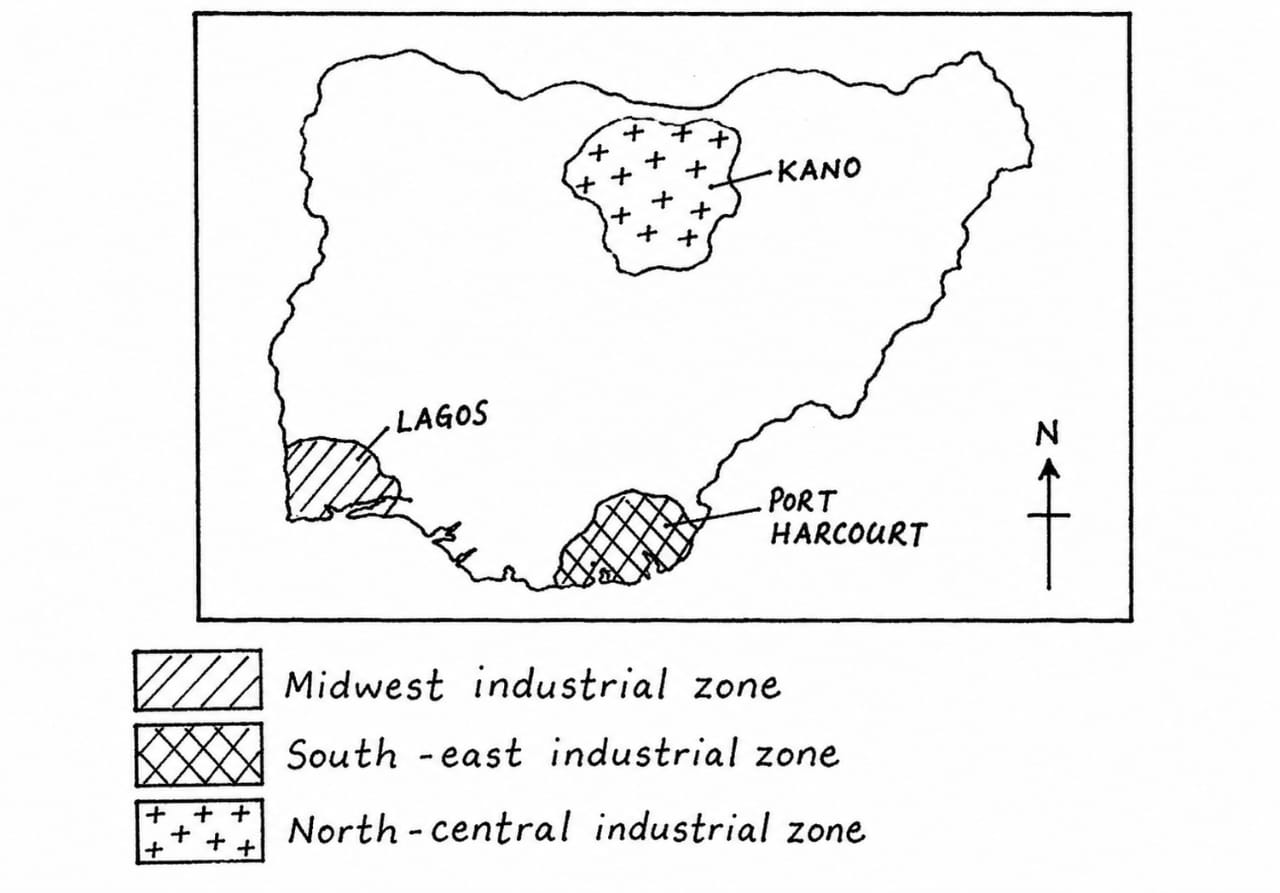
(6b)
(i) Employment Generation: Manufacturing industries provide employment opportunities for skilled and unskilled labour, thereby reducing unemployment and improving the standard of living. Examples include the Dangote Cement Plc, Nestlé Nigeria Plc, and Nigerian Breweries Plc, which employ thousands of workers.
(ii) Provision of Raw Material Processing and Value Addition: Manufacturing industries process raw materials into finished or semi-finished goods, thereby increasing their value and reducing wastage. For example, cocoa is processed into chocolate and beverages, cotton into textiles, crude oil into petroleum products, and timber into furniture.
(iii) Generation of Revenue and Foreign Exchange: Manufacturing industries contribute to government revenue through taxes and also earn foreign exchange through the export of manufactured products such as cement, textiles, processed foods, and chemicals. This strengthens Nigeria’s economy and promotes industrial development.
(6c)
(i) Inadequate power supply.
(ii) Poor transportation and communication facilities.
(iii) Inadequate capital and access to finance.
(iv) High cost or inadequate supply of raw materials.
===================================
COMPLETED….We Remain Your Favourite Site.
Ensure You Subscribe For Your Next Paper
===================================
Leave a Reply