
 HOME
 WAEC
 NECO
 07048281409

BEST EXPO RUNZ ASSISTANCE WEBSITE. NO.1 BEST DELIVERY OF EXAM RUNZ
100% GUARANTEE OF GETTING ANSWERS MIDNIGHT..IT’S OUR CULTURE, NO DOUBT
═══════════════════════════
FABRICATION OBJ
01-10:CBDACBBAAA
11-20: ADCABCBCAB
21-30: BDCDAADBDC
31-40: BDBADAADDA
COMPLETED
═══════════════════════════
INSTITUTION: ANSWER FIVE(5) QUESTIONS ONLY
(1a)
Marking out is the process of transferring measurements, dimensions and shapes from a drawing or plan onto the surface of a metal workpiece to guide cutting, drilling, bending or fabrication.
(1b)
(i) Wear appropriate personal protective equipment such as welding helmets, gloves and safety boots.
(ii) Ensure that the workshop is properly ventilated to prevent the accumulation of harmful fumes.
(iii) Keep flammable materials away from the welding area to prevent fire outbreaks.
(iv) Inspect welding machines, cables and connections before use to ensure they are in good condition.
(v) Keep fire extinguishers and other fire-fighting equipment readily available.
═══════════════════════════
(2a)
Hemming is the process of folding the edge of a sheet metal over itself to form a smooth, rounded or reinforced edge.
(2b)
[IN A TABULAR FORM]
=UNDER HOLLOWING=
(i) It is the process of producing a hollow or concave shape in a metal sheet.
(ii) The metal is worked into a depression using a hollowing block or suitable tools.
(iii) It is commonly used to produce bowls, dishes and similar hollow objects.
=UNDER RAISING=
(i) It is the process of forming a flat metal sheet into a raised or curved shape.
(ii) The metal is hammered over a stake or raising tool to form the desired shape.
(iii) It is commonly used to produce curved vessels, containers and raised metal forms.
(2c)
(i) To increase the strength and rigidity of sheet metal.
(ii) To prevent bending, buckling and deformation of the metal.
═══════════════════════════
(3a)
[IN A TABULAR FORM]
=UNDER GAS WELDING=
(i) Heat is produced by burning a mixture of fuel gas and oxygen.
(ii) It uses a gas welding torch and gas cylinders.
(iii) It is generally slower and produces a lower heat concentration.
=UNDER ARC WELDING=
(i) Heat is produced by an electric arc between the electrode and the workpiece.
(ii) It uses an arc welding machine, electrode holder and electrodes.
(iii) It produces a higher heat concentration and is generally faster for many welding operations.
(3b)
(i) Type of base metal: The filler rod should be compatible with the material being welded to ensure a sound joint.
(ii) Thickness of the metal: The diameter of the filler rod should be suitable for the thickness of the workpiece.
(iii) Type of welding process: The filler rod selected must be suitable for the welding process and the operating conditions.
═══════════════════════════
(4)
(i) Tensile force is a pulling force that acts on a material in opposite directions, causing it to stretch or elongate. It tends to increase the length of the material and may cause it to break if the force exceeds its strength.
(ii) Shear stress is the internal resistance developed in a material when an external force acts parallel or tangential to its cross-sectional area. It tends to cause one part of the material to slide over another.
(iii) A critical point is a particular temperature at which a metal undergoes an important structural or phase change during heating or cooling. In steel, critical temperatures are associated with changes in its internal structure during heat treatment.
(iv) Tempering is a heat-treatment process in which hardened steel is reheated to a temperature below its critical temperature, held for a period and then cooled. It reduces brittleness, relieves internal stresses and improves toughness.
═══════════════════════════
(5i)
(i) Insufficient welding current or heat input.
(ii) Incorrect electrode angle or improper welding technique.
(5ii)
(i) Failure to remove slag from a previous weld pass before depositing another pass.
(ii) Incorrect electrode angle or poor welding technique, causing slag to become trapped in the weld.
(5iii)
(i) Presence of moisture, oil, rust or dirt on the surface of the workpiece or electrode.
(ii) Inadequate shielding of the weld pool due to poor gas flow or air drafts.
═══════════════════════════
(6a)
(i) Wear a proper welding helmet with the correct filter lens to protect the eyes and face from arc rays and sparks.
(ii) Ensure that the welding cables, electrode holder and electrical connections are properly insulated to prevent electric shock.
(iii) Work in a well-ventilated area to prevent inhalation of harmful welding fumes.
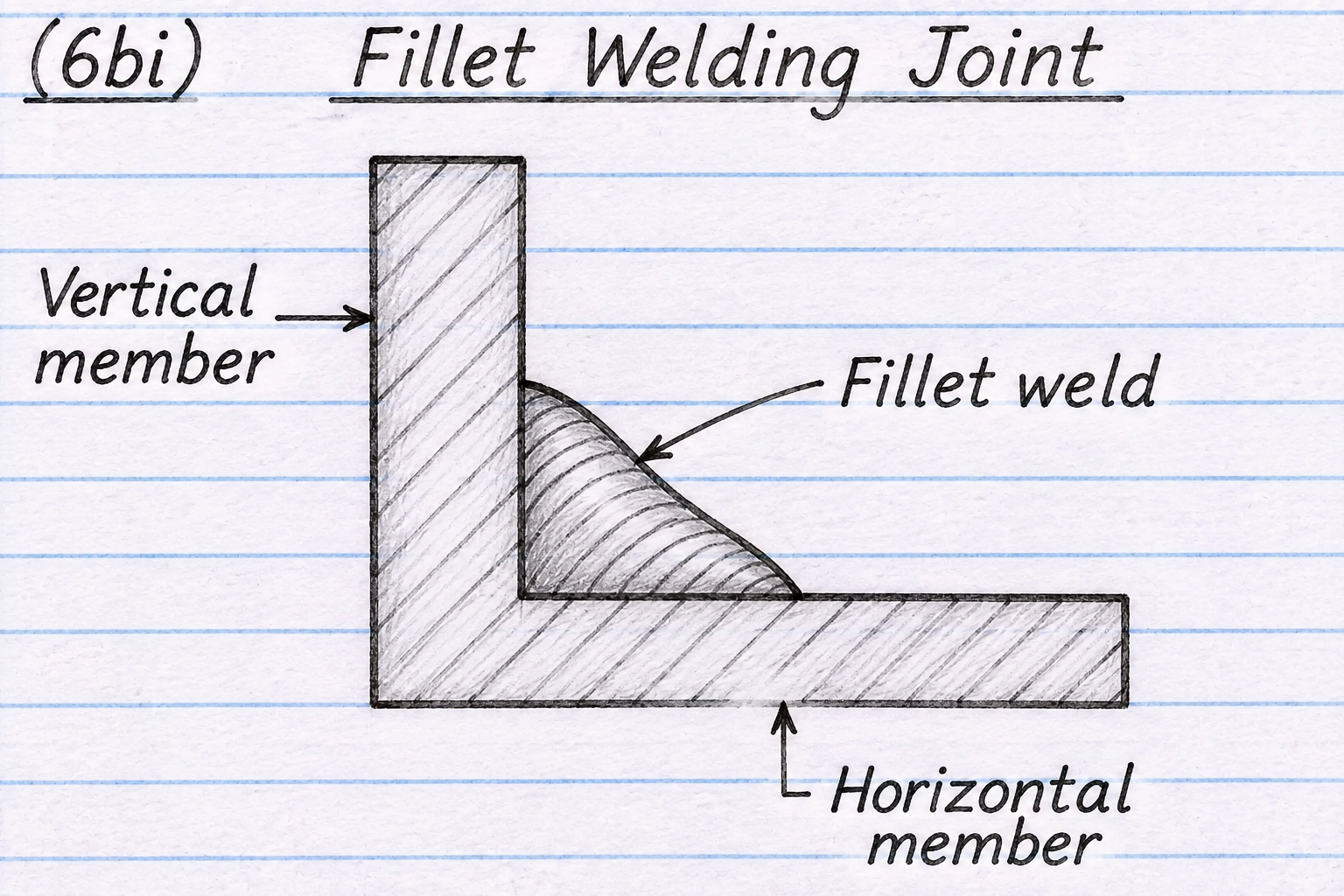
(6bi)
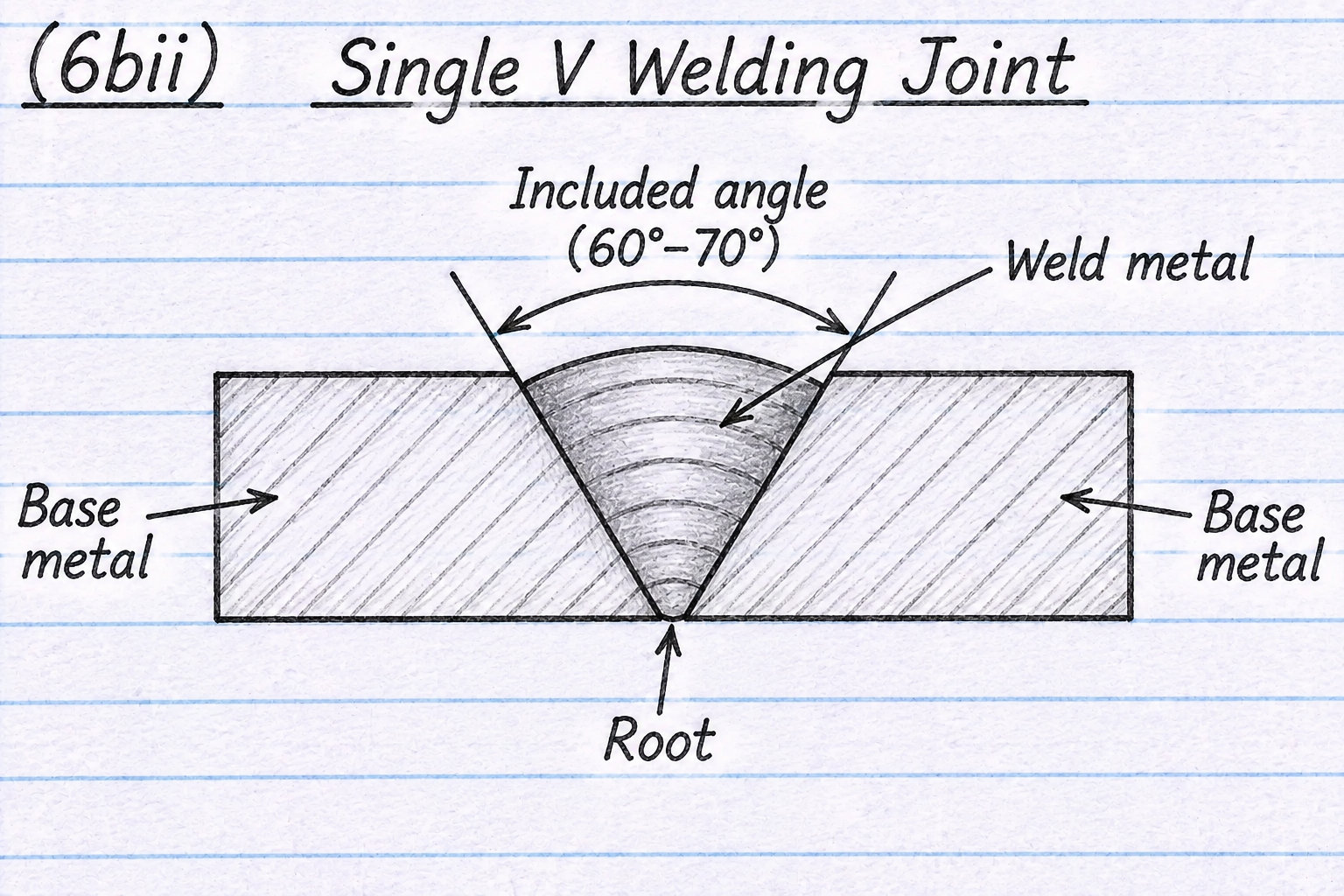
(6bii)
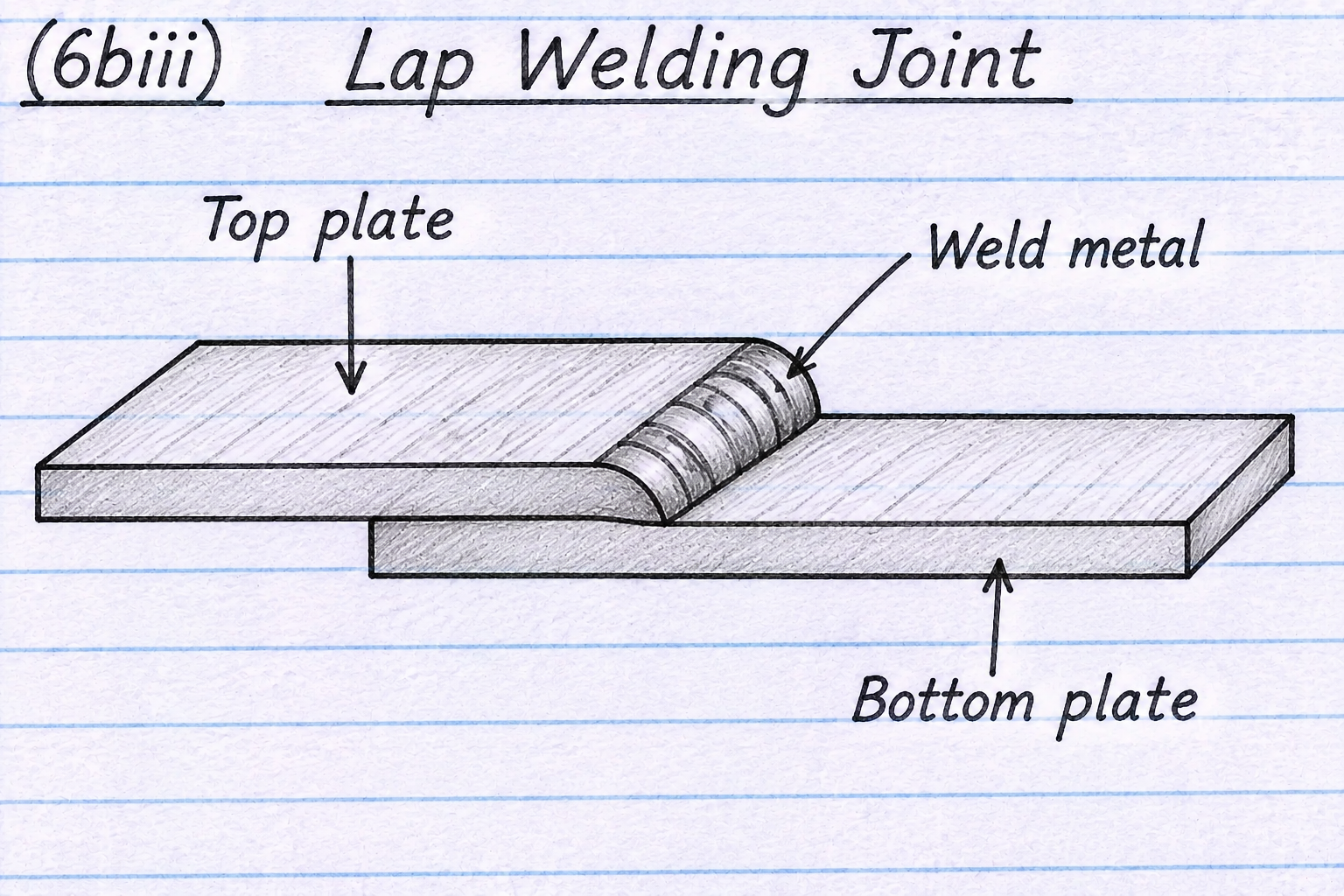
(6biii)
═══════════════════════════
(7a)
Weaving is the side-to-side movement of the welding electrode during welding to produce a wider weld bead and ensure proper filling of the joint.
(7b)
(i) Thickness of the material: The thickness of the metal determines the type of joint suitable for the work.
(ii) Strength required: The joint selected must be strong enough to withstand the loads and stresses expected during service.
(7c)
Joints should be devoid of flaws to ensure maximum strength and prevent premature failure or fracture during service.
═══════════════════════════
COMPLETED….We Remain Your Favourite Site.
Ensure You Subscribe For Your Next Paper
═══════════════════════════
Leave a Reply