
 HOME
 WAEC
 NECO
 07048281409

BEST EXPO RUNZ ASSISTANCE WEBSITE. NO.1 BEST DELIVERY OF EXAM RUNZ
100% GUARANTEE OF GETTING ANSWERS MIDNIGHT..IT’S OUR CULTURE, NO DOUBT
═══════════════════════════
BIOLOGY OBJ
01-10: CABBCBCCBC
11-20: BCCBACCBAB
21-30: BBAAAADACC
31-40: CCAABACCBA
41-50: CACBDCDACC
COMPLETED
═══════════════════════════
INSTRUCTION: ANSWER FOUR(4) QUESTIONS ONLY, AT LEAST ONE(1) QUESTION FROM EACH PART
PART I
(1ai)
A microscope is an instrument used to magnify and view very small objects or organisms that cannot be seen clearly with the naked eye.
(1aii)
(i) Eyepiece
(ii) Objective lenses
(iii) Stage
(iv) Coarse adjustment knob
(v) Fine adjustment knob
(vi) Mirror
(1aiii)
(i) Eyepiece: It magnifies the image formed by the objective lens for the observer to view.
(ii) Objective lenses: They provide the main magnification of the specimen at different powers.
(iii) Stage: It holds the slide carrying the specimen in position during observation.
(iv) Coarse adjustment knob: It moves the body tube up or down quickly to bring the specimen roughly into focus.
(v) Fine adjustment knob: It makes small movements to sharpen the focus of the image.
(vi) Mirror: It reflects light onto the specimen to illuminate it.
(1b)
(i) Binary fission.
(ii) Multiple fission.
(iii) Budding.
(iv) Spore formation.
(v) Fragmentation.
═══════════════════════════
PART II
(2a)
Self-pollination is the transfer of pollen grains from the anther to the stigma of the same flower or to the stigma of another flower on the same plant of the same species.
(2b)
[IN TABULAR FORM]
=UNDER WIND-POLLINATED FLOWERS=
(i) Flowers are usually small and inconspicuous.
(ii) Petals are usually dull-coloured.
(iii) They usually have no scent or nectar.
(iv) Pollen grains are small, light and produced in large quantities.
(v) Stigmas are usually large, feathery and exposed.
= UNDER INSECT-POLLINATED FLOWERS=
(i) Flowers are usually large and conspicuous.
(ii) Petals are usually brightly coloured.
(iii) They usually produce scent and nectar.
(iv) Pollen grains are usually sticky or rough and produced in smaller quantities.
(v) Stigmas are usually sticky and located inside the flower.
(2ci)
(i) Wind.
(ii) Water.
(iii) Animals.
(2cii)
(i) Wind: Cotton and dandelion.
(ii) Water: Coconut and water lily.
(iii) Animals: Mango and guava.
═══════════════════════════
(3a)
Osmosis is the movement of water molecules from a region of higher water concentration (dilute solution) to a region of lower water concentration (concentrated solution) through a selectively permeable membrane.
(3b)
(i) Osmosis involves only the movement of water molecules, while diffusion involves the movement of different particles, such as molecules and ions.
(ii) Osmosis requires a selectively permeable membrane, while diffusion can take place with or without a membrane.
(iii) Osmosis occurs in liquid medium, while diffusion occurs in gases and liquids.
(iv) Osmosis is the movement of water from a region of higher water potential to a region of lower water potential, while diffusion is the movement of particles from a region of higher concentration to a region of lower concentration.
(3c)
(i) Gaseous exchange in animals: Oxygen diffuses from the air in the lungs into the blood, while carbon dioxide diffuses from the blood into the lungs for removal.
(ii) Gaseous exchange in plants: Carbon dioxide diffuses into leaves through the stomata for photosynthesis, while oxygen diffuses out.
(iii) Absorption of digested food: Some digested food substances, such as glucose, diffuse from the small intestine into the blood through the intestinal wall.
(iv) Removal of waste products: Carbon dioxide produced during cellular respiration diffuses from body cells into the blood, from where it is transported to the lungs for removal.
═══════════════════════════
PART III
(4ai)
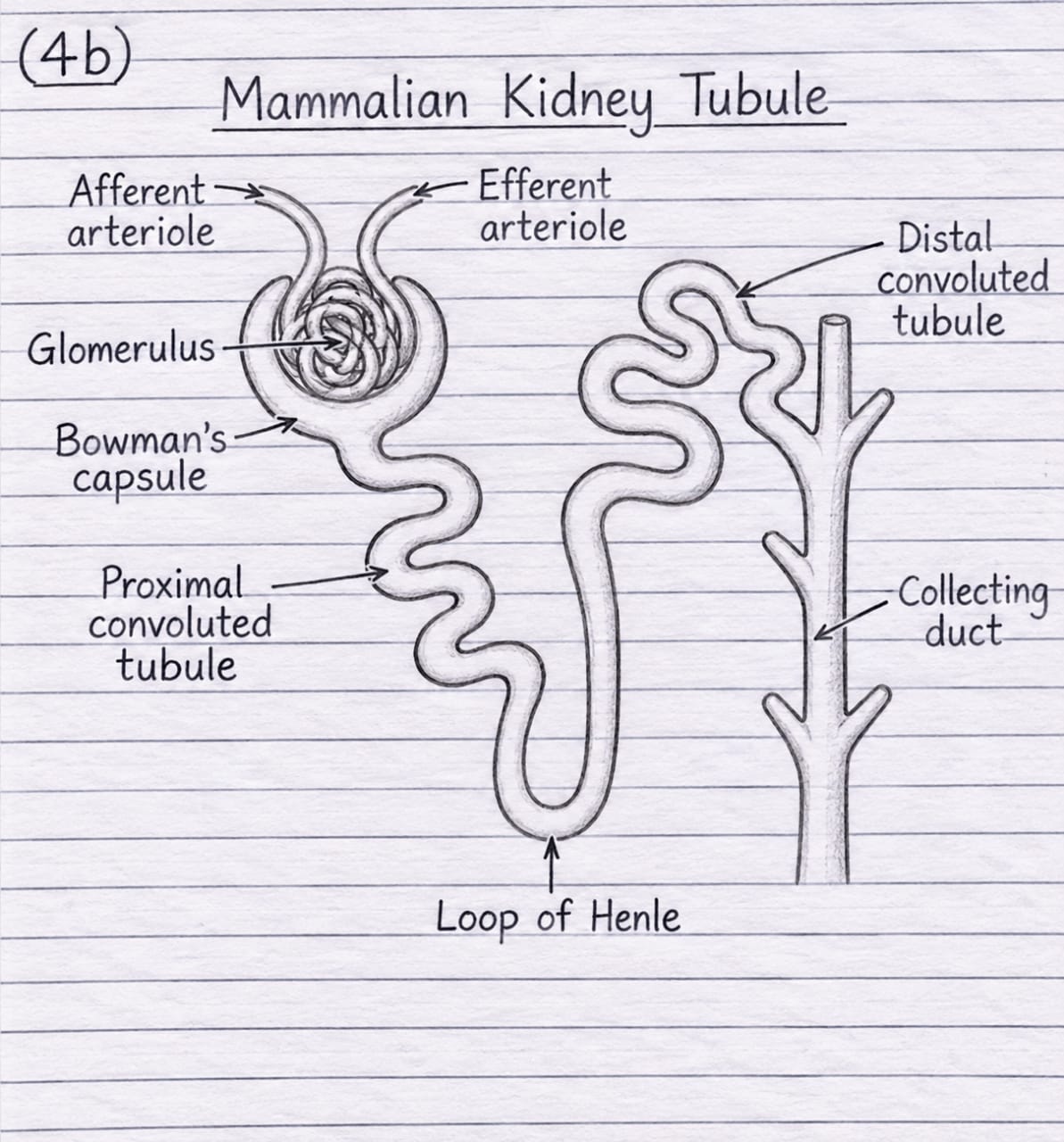
(i) Excretion: It removes nitrogenous wastes such as urea from the blood.
(ii) Osmoregulation: It regulates the water and salt content of the blood.
(iii) Regulation of blood pH: It controls the acidity of the blood by removing excess hydrogen ions.
(4aii)
(i) Excretion: Blood enters the kidney through the renal artery and flows into the glomerulus, where high pressure forces water, glucose, salts, amino acids and urea into Bowman’s capsule through ultrafiltration. As the filtrate passes along the kidney tubule, useful substances such as glucose, amino acids and most of the water and salts are selectively reabsorbed into the blood. The remaining wastes and excess water and salts form urine, which passes through the collecting duct to the ureter and is stored in the urinary bladder before excretion.
(ii) Osmoregulation: When the blood is too concentrated, the pituitary gland releases more antidiuretic hormone (ADH), which increases water reabsorption in the distal convoluted tubule and collecting duct. This produces a small quantity of concentrated urine. When the blood is too dilute, less ADH is released, resulting in less water reabsorption and a large quantity of dilute urine. This helps maintain the water balance of the body.
(4b)
(4ci)
(i) Contractile vacuole.
(ii) Flame cells.
(4cii)
(i) Kidneys.
(ii) Lungs.
═══════════════════════════
(5ai)
(i) Eyes.
(ii) Ears.
(iii) Nose.
(iv) Tongue.
(v) Skin.
(5aii)
(i) Eyes: They are responsible for the sense of sight.
(ii) Ears: They are responsible for hearing and maintaining body balance.
(iii) Nose: It is responsible for the sense of smell.
(iv) Tongue: It is responsible for the sense of taste.
(v) Skin: It detects touch, pressure, pain, heat and cold.
(5bi)
A joint is the point at which two or more bones meet or are connected in the skeleton, which allows the bones to move or to be held together.
(5bii)
(i) Ball-and-socket joint: Found at the shoulder and hip.
(ii) Hinge joint: Found at the elbow, knee and fingers.
(iii) Pivot joint: Found between the atlas and axis vertebrae in the neck, allowing rotation of the head.
(iv) Gliding joint: Found between the carpal bones of the wrist and the tarsal bones of the ankle.
(v) Fixed (immovable) joint: Found between the bones of the skull.
═══════════════════════════
PART IV
(6a)
(i) Mendel’s First Law (Law of Segregation): This states that the two alleles controlling a character separate during the formation of gametes, so that each gamete receives only one allele.
(ii) Mendel’s Second Law (Law of Independent Assortment): This states that alleles of different genes separate and are inherited independently of one another during gamete formation, provided the genes are not linked.
(6b)
(i) Skin colour
(ii) Eye colour
(iii) Blood group
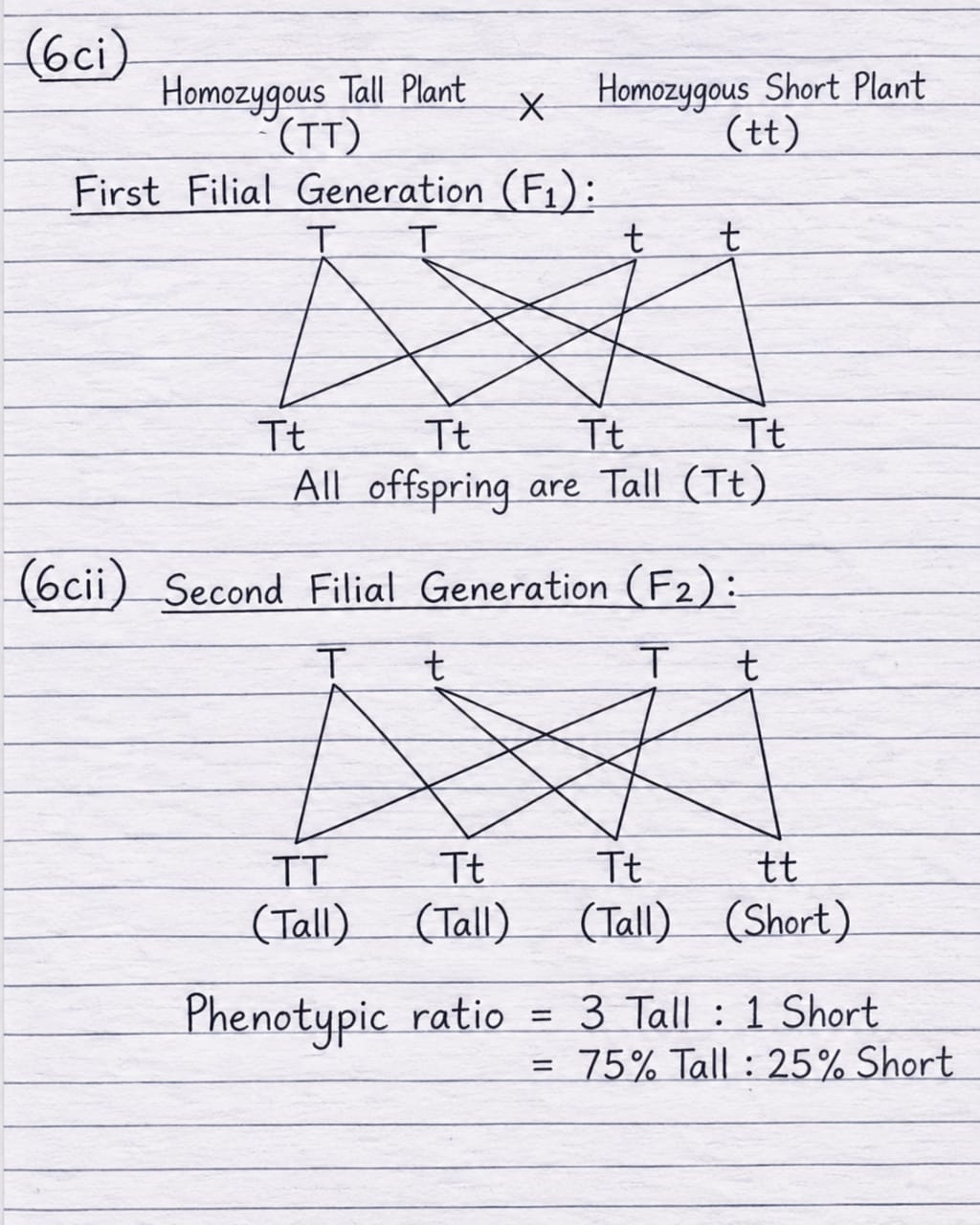
(6ci) & (6cii)
═══════════════════════════
COMPLETED….We Remain Your Favourite Site.
Ensure You Subscribe For Your Next Paper
═══════════════════════════
Leave a Reply