
 HOME
 WAEC
 NECO
 07048281409

BEST EXPO RUNZ ASSISTANCE WEBSITE. NO.1 BEST DELIVERY OF EXAM RUNZ
100% GUARANTEE OF GETTING ANSWERS MIDNIGHT..IT’S OUR CULTURE, NO DOUBT
═══════════════════════════
SECTION A: ANSWER ALL QUESTIONS
(1a)
A jig is a device used to hold, guide or position a workpiece or cutting tool during furniture construction. It helps to ensure accuracy, uniformity and consistency when performing operations such as drilling, cutting and assembling furniture components.
(1b)
Moulds are used in furniture making for shaping and producing decorative components such as curved legs, carved ornaments, moulded edges and other repeated furniture parts.
═══════════════════════════
(2i)
(i) Measure the wall and determine the required panel sizes.
(ii) Prepare the wall by cleaning it and removing any projections.
(iii) Cut the plywood panels to the required dimensions.
(iv) Mark out the positions for fixing the panels.
(v) Apply suitable adhesive or install battens to support the panels.
(vi) Position the plywood panels and fix them with screws or nails.
(vii) Check the alignment and finish the joints and edges.
(2ii)
(i) Measure the office and mark the position of the proposed partition.
(ii) Prepare the hardwood members for the framework.
(iii) Fix the hardwood base, top and side members securely to the floor, ceiling and walls.
(iv) Install vertical and horizontal hardwood supports at suitable intervals.
(v) Cut the finished particle boards to the required sizes.
(vi) Fix the particle boards to both sides of the hardwood framework using screws or nails.
(vii) Cover exposed edges and joints with suitable mouldings or trims.
(viii) Inspect the partition and ensure that it is firm, straight and properly finished.
═══════════════════════════
(3)
Submersion is a wood preservation method in which timber is completely immersed in a suitable preservative solution for a specified period. The timber is placed in a treatment tank containing the preservative so that the chemical can penetrate the wood and protect it against fungi, termites and other wood-destroying organisms. After treatment, the timber is removed and allowed to drain and dry before use.
═══════════════════════════
(4)
(i) It should be smooth, even and free from scratches, dents and rough patches.
(ii) It should have a uniform colour and finish without visible defects or stains.
═══════════════════════════
(5)
(i) Blistering: Caused by applying varnish over a damp or poorly prepared surface, or by trapped air or moisture beneath the coating.
(ii) Bloom: Caused by moisture or high humidity during varnishing, resulting in a cloudy or milky appearance.
(iii) Sags: Caused by applying varnish too heavily or using an excessively thin mixture, causing it to run down the surface before drying.
(iv) Specks: Caused by dust, dirt or other foreign particles settling on the wet varnish during application or drying.
═══════════════════════════
(6)
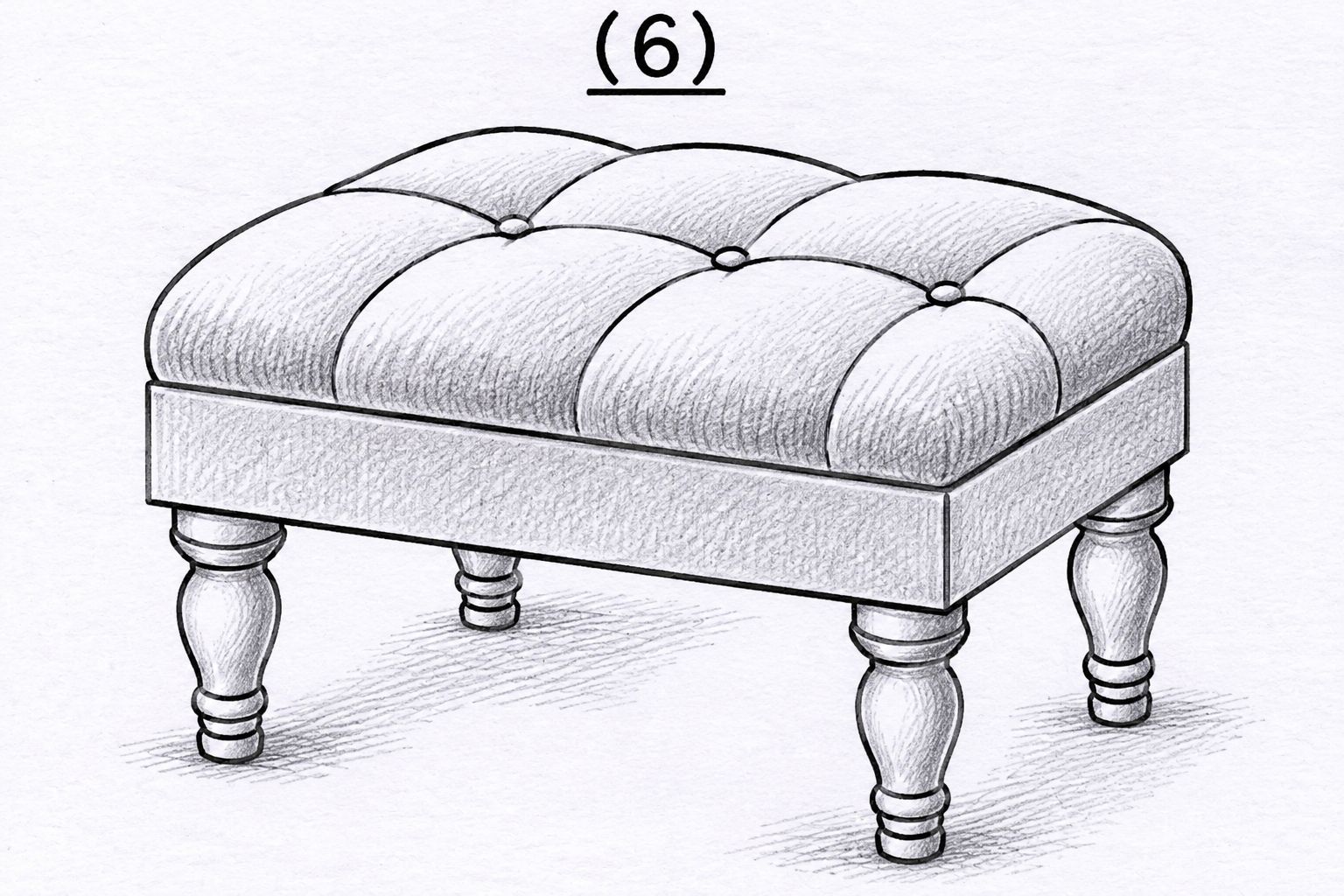
═══════════════════════════
(7)
(i) Study the working drawing and identify the parts of the stool.
(ii) Determine the dimensions and quantity of each component.
(iii) Select suitable timber according to the required sizes and quality.
(iv) Allow for planing, trimming and machining where necessary.
(v) Calculate the total number and sizes of timber pieces required.
(vi) Arrange the components according to their dimensions and prepare the cutting list.
═══════════════════════════
(8i)
(i) It should be strong and durable to withstand weight and regular use.
(ii) It should be well-seasoned with low moisture content to prevent shrinkage and warping.
(iii) It should be free from defects such as large knots, cracks and decay.
(8ii)
(i) Durability and resistance to wear and tear.
(ii) Colour, pattern and suitability for the furniture design.
(iii) Ease of cleaning and maintenance.
═══════════════════════════
(9)
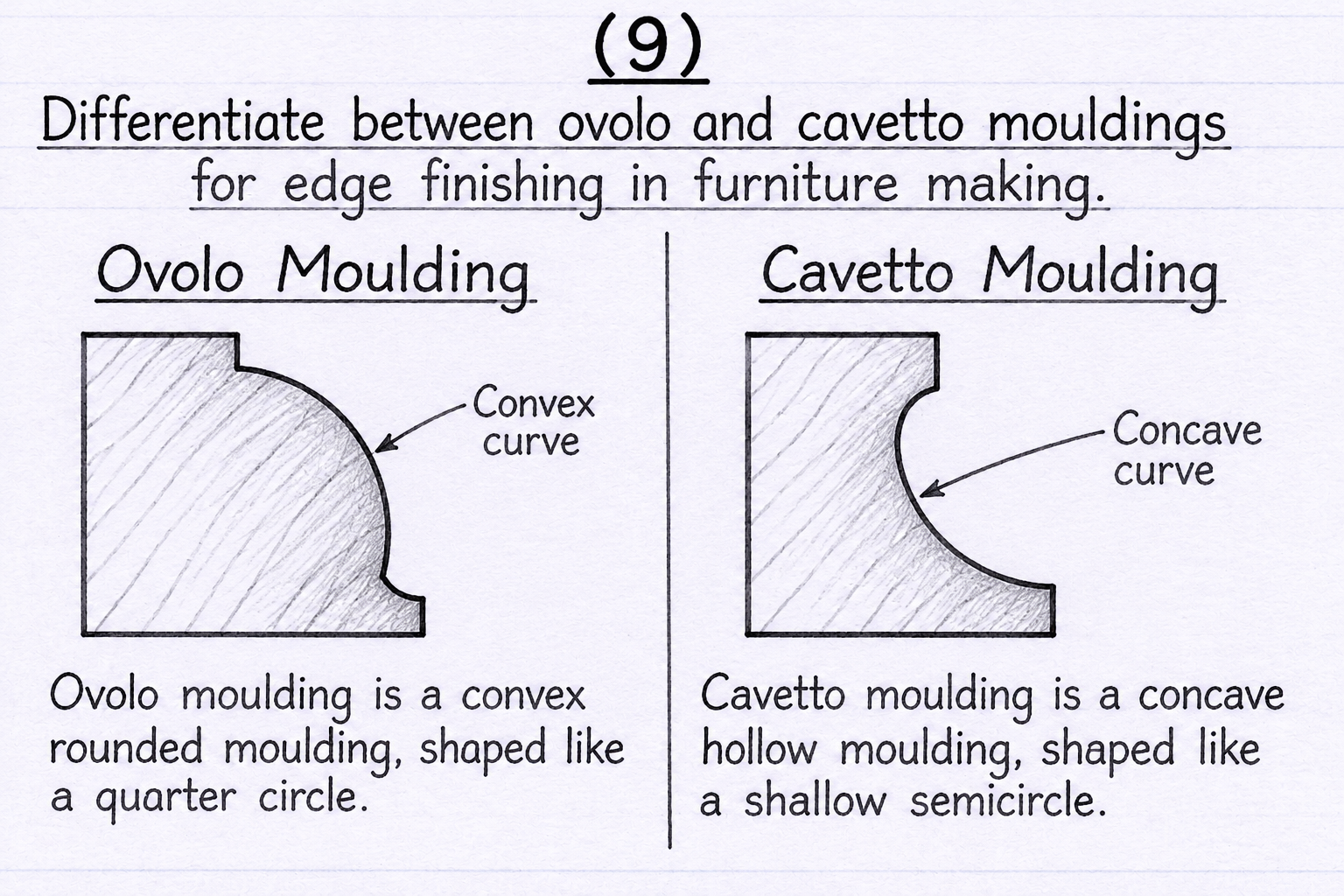
═══════════════════════════
(10a)
Glass is made by mixing silica sand with soda ash and limestone in the correct proportions. The mixture is heated in a furnace at a very high temperature until it melts into a liquid. The molten glass is then shaped by blowing, pressing, rolling or drawing, depending on the desired product. It is gradually cooled through a controlled process called annealing to prevent internal stresses and cracking.
(10b)
(i) Butt joint.
(ii) Mortise and tenon joint.
═══════════════════════════
SECTION B: ANSWER FOUR(4) QUESTIONS ONLY
(12)
(i) Horse hair: Horsehair is traditionally used as stuffing material in cushions, seat pads, chair backs and armrests. It provides firm support and has good resilience, allowing it to spring back after compression. It is also breathable and helps maintain the shape of upholstered furniture.
(ii) Feathers: Feathers are used as soft filling materials in cushions, pillows, loose seat pads and backrests. They provide a soft, comfortable and luxurious feel. They are flexible and can be adjusted easily to give upholstered furniture a fuller appearance.
(iii) Grass: Dried grass is traditionally used as stuffing material for seats, chair backs and cushions. It provides a firm and economical filling for upholstered furniture. However, it may gradually become compressed and lose some of its original shape after prolonged use.
═══════════════════════════
(13)
(i) Lightweight: Synthetic foam has a low weight, making upholstered furniture easy to handle, move and transport. It does not add excessive weight to the furniture frame, even when used in large quantities.
(ii) Resilience: It has the ability to return to its original shape after being compressed by the weight of a person. This helps the cushions and seats maintain their shape and provide continuous support during use.
(iii) Softness and comfort: Synthetic foam provides cushioning that reduces pressure on the body when sitting or lying down. Different grades and densities are available to provide varying levels of softness and firmness for seats, backs and cushions.
(iv) Durability: Good-quality synthetic foam can withstand repeated compression and everyday use without quickly breaking down. It maintains its cushioning properties for a reasonable period, thereby extending the useful life of upholstered furniture.
(v) Ease of cutting and shaping: Synthetic foam can be easily cut, trimmed and shaped into different sizes and designs to suit various furniture structures. This makes it suitable for upholstering chairs, sofas, mattresses, cushions and other furniture components.
═══════════════════════════
(14a)
(i) Durability and strength: The fabric should be strong enough to withstand regular use, friction and stretching without tearing or wearing out quickly. Durable fabrics are suitable for furniture that is used frequently.
(ii) Colour and design: The colour, pattern and texture of the fabric should match the style and appearance of the furniture and the surrounding interior decoration. Attractive designs improve the overall appearance of upholstered furniture.
(iii) Ease of cleaning and maintenance: The fabric should be easy to clean and maintain, especially when used on furniture that is frequently exposed to dust, stains and spills. Fabrics that resist stains and do not fade easily are preferable.
(14b)
(i) Selection of a suitable fabric backing, such as cotton or polyester.
(ii) Cleaning and preparation of the backing material to ensure proper adhesion.
(iii) Application of a layer of PVC or polyurethane coating to the backing.
(iv) Embossing the coated surface with a leather-like grain pattern.
(v) Applying colour and protective finishing coatings to improve its appearance and durability.
(vi) Drying, cooling and inspecting the finished material before cutting and packaging.
═══════════════════════════
(15a)
(i) Pigment.
(ii) Binder or vehicle.
(iii) Solvent or thinner.
(iv) Drier.
(v) Extender or filler.
(vi) Additives.
(15b)
(i) Oil-based paint: This is a type of paint made with oil or an oil-modified resin as its binding medium. It produces a hard, durable finish and is commonly used on wood and metal surfaces.
(ii) Emulsion paint: This is a water-based paint in which synthetic resin is dispersed in water. It dries quickly and is commonly used on interior walls and ceilings.
Difference: Oil-based paint uses oil or an oil-modified resin as its binding medium and takes longer to dry, while emulsion paint uses water as its main solvent and dries more quickly.
═══════════════════════════
COMPLETED….We Remain Your Favourite Site.
Ensure You Subscribe For Your Next Paper
═══════════════════════════
Leave a Reply