
 HOME
HOME
 WAEC
WAEC
 NECO
NECO
 09041131939

BEST EXPO RUNZ ASSISTANCE WEBSITE. NO.1 BEST DELIVERY OF EXAM RUNZ
100% GUARANTEE OF GETTING ANSWERS MIDNIGHT..IT’S OUR CULTURE, NO DOUBT
===================================
AGRIC OBJ
01-10: BEBDAEBDCD
11-20: EECBEEDDAD
21-30: DBADBCECBB
31-40: EBCEAADEEA
41-50: DBECDBEAEC
51-60: CCBBCAEDDD
COMPLETED
===================================
INSTRUCTION: ANSWER FIVE(5) QUESTIONS IN ALL, ONE FROM EACH SECTION
SECTION A
(1a)
Agriculture is the science, art, and business of cultivating the soil, producing crops, and raising livestock. it includes the preparation of plant and animal products for people to use and their distribution to markets.
(1bi)
=Unpredictable climate=
(i) Irrigation farming: helps ensure a steady water supply during drought or irregular rainfall.
(ii) Use of climate-resilient crop varieties: planting drought-tolerant or flood-resistant crops.
(iii) Weather forecasting and early warning systems: to inform farmers of expected weather patterns and guide their farming activities.
(1bii)
=Rural-urban migration=
(i) Provision of rural infrastructure: such as electricity, roads, and potable water to improve rural living standards.
(ii) Creation of agro-based industries in rural areas: to provide employment opportunities.
(iii) Access to credit and farming inputs: to encourage youth participation in agriculture.
(1c)
(i) Wear protective clothing and equipment to avoid chemical contact.
(ii) Avoid spraying during windy conditions to prevent drift to unintended areas.
(iii) Follow recommended dosage and application guidelines to avoid overuse and contamination.
(iv) Keep chemicals away from water sources to prevent pollution.
(1d)
(i) Increases farming efficiency by accelerating tasks such as ploughing, planting, and harvesting.
(ii) Reduces labor intensity and dependency on manual labor.
(iii) Enables cultivation of larger areas of land, boosting productivity.
(iv) Improves timeliness of farm operations leading to better crop yields.
===================================
(2a)
(i) Communal land tenure
(ii) Individual or freehold land tenure
(iii) Leasehold land tenure
(2b)
(i) Provision of subsidies and credit facilities to support farmers.
(ii) Construction of rural infrastructure such as roads and irrigation systems.
(iii) Establishment of agricultural research institutes to improve farming methods and yields.
(2c)
(i) International Institute of Tropical Agriculture (IITA)
(ii) Technoserve Nigeria
(iii) Sasakawa Global 2000
(2d)
(i) Introduction of modern farm machinery such as tractors, harvesters, and planters.
(ii) Training farmers and technicians in the use and maintenance of machines.
(iii) Establishing tractor hiring units or service centres to increase access to machinery for small-scale farmers.
(2e)
(i) High cost of purchase and maintenance of machines.
(ii) Unemployment due to displacement of manual labourers.
(iii) Soil compaction caused by heavy machinery, which can reduce soil fertility.
(iv) Inaccessibility to small or fragmented farms, making mechanisation difficult.
===================================
SECTION B
(3ai)
A soil profile is a vertical section of the soil that shows its different layers or horizons from the surface to the underlying rock. Each horizon has distinct characteristics such as texture, colour, and composition.
(3aii)
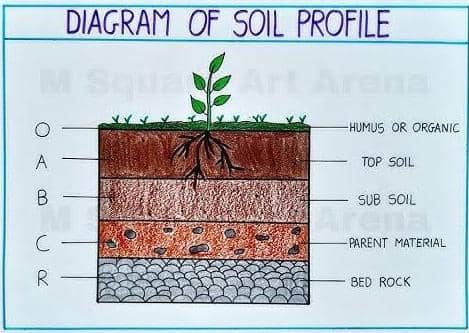
(3b)
(i) Leaching of basic nutrients such as calcium and magnesium by heavy rainfall.
(ii) Use of acid-forming fertilizers like ammonium sulfate and urea.
(iii) Decomposition of organic matter, releasing organic acids.
(iv) Parent material rich in acidic minerals, such as granite.
(3c)
(i) Broadcasting: This involves evenly spreading fertilizer over the entire field surface either manually or mechanically. It is suitable for crops grown in rows or densely planted fields but may lead to wastage and uneven distribution.
(ii) Side dressing: Fertilizer is applied beside growing plants in shallow trenches or bands. It supplies nutrients directly to the root zone and is common with maize, tomatoes, and other row crops.
(iii) Foliar application: This involves spraying diluted liquid fertilizers directly onto the leaves of plants. Nutrients are absorbed through the stomata. It is useful for quick nutrient correction but must be carefully applied to avoid leaf burn.
===================================
(4a)
(i) Microorganisms decompose dead plants and animals into simpler substances, thereby contributing organic matter to the soil.
(ii) They produce organic acids during metabolism, which help to break down rocks and minerals, aiding in soil development.
(iii) Certain soil bacteria, such as Rhizobium, fix atmospheric nitrogen into the soil, enriching it with essential nutrients.
(iv) Microorganisms promote mineral weathering by secreting enzymes and compounds that dissolve mineral particles into usable forms.
(4bi)
=Functions=
(i) Constituent of chlorophyll, essential for photosynthesis.
(ii) Aids enzyme activation, particularly those involved in energy transfer and protein synthesis.
(4bii)
=Deficiency symptoms=
(i) Interveinal chlorosis
(ii) Premature leaf drop
(4c)
(i) Green manure:
Green manure refers to fast-growing plants (often legumes) grown and ploughed back into the soil to improve its organic matter content and fertility.
(ii) Farm yard manure:
Farm yard manure is a mixture of animal dung, urine, bedding materials, and leftover feed from farm animals, decomposed and used to enrich the soil.
(iii) Compost manure:
Compost manure is produced by decomposing organic household or farm waste (such as crop residues and kitchen scraps) in a controlled environment to create nutrient-rich humus.
(4d)
(i) Biotic components: The living organisms such as plants, animals, and microorganisms.
(ii) Abiotic components: The non-living environmental factors such as soil, water, air, and minerals.
===================================
SECTION C
(5ai)
Rainfall requirement: Oil palm requires a high and evenly distributed annual rainfall of about 1,500 to 2,500 mm, without prolonged dry periods.
(5aii)
Transplanting date: Transplanting of oil palm seedlings is best done at the beginning of the rainy season, usually between April and May in southern Nigeria, to ensure adequate moisture.
(5aiii)
Fertilizer requirement: Oil palm requires balanced application of fertilizers such as NPK 15:15:15 and magnesium sulphate, applied in split doses to enhance growth and fruit yield.
(5aiv)
(i) Weeding: Regular weeding is done manually or chemically to reduce competition for nutrients.
(ii) Mulching: Helps to conserve soil moisture and suppress weed growth.
(iii) Pruning: Old or dead fronds are pruned to allow proper light penetration and ease of harvesting.
(5av)
(i) Basal stem rot
(ii) Bunch rot
(iii) Bud rot
(5b)
(i) Direct seeding into flower beds or garden soil.
(ii) Transplanting seedlings raised in nurseries to permanent sites.
(iii) Propagation by cuttings, where stem or leaf cuttings are rooted and grown into mature plants.
(5c)
(i) Crop rotation helps to break the life cycle of weeds.
(ii) Mulching suppresses weed growth by blocking sunlight.
(iii) Regular tillage destroys emerging weed seedlings.
(iv) Cover cropping shades the soil and outcompetes weeds for nutrients.
===================================
(6a)
(i) They destroy crops in the field through activities such as sucking, chewing, boring, and defoliation, causing yield loss.
(ii) They reduce the quality and nutritional value of crops, making them unattractive and unmarketable.
(iii) They increase production costs as farmers spend money on pest control measures.
(iv) Some insect pests act as vectors, transmitting diseases that predispose crops to further infection and damage.
(6bi)
=Cassava mosaic=
(i) Mottled or mosaic yellow and green patterns on the leaves.
(ii) Distorted or stunted leaf and stem growth.
(6bii)
=Groundnut rosette=
(i) Yellowing and curling of leaves.
(ii) Stunted growth with little or no pod formation.
(6biii)
=Root knot of okra=
(i) Swellings or galls on the roots.
(ii) Wilting and poor plant growth due to impaired water and nutrient uptake.
(6c)
(i) One material for propagation: Yam is propagated using tuber setts or whole small tubers.
(ii) Soil requirement: Yam grows best in well-drained, fertile sandy loam soils rich in organic matter.
(iii) Land preparation: Land should be cleared and prepared by mounding, ridging, or heaping to provide good drainage and aeration.
(iv) Planting date: Planting is usually done at the start of the rainy season, typically between March and April.
(v) Spacing: Recommended spacing is about 1 meter by 1 meter between plants.
(vi) One cultural practice: Staking is a cultural practice used to support yam vines and improve exposure to sunlight.
===================================
SECTION D
(7ai)
(i) Reduced productivity due to poor growth, low milk, or egg yield.
(ii) Increased cost of treatment and veterinary care.
(iii) Loss of animals leading to financial loss for farmers.
(iv) Restrictions on trade and movement of infected animals, affecting income.
(7aii)
(i) Regular vaccination of animals.
(ii) Quarantine of new or sick animals.
(iii) Proper sanitation and hygiene in animal housing.
(iv) Provision of balanced and adequate nutrition.
(v) Regular deworming and parasite control.
(vi) Prompt removal and proper disposal of dead animals.
(7b)
(i) Vaccination of susceptible animals against the disease.
(ii) Isolation and quarantine of infected animals.
(iii) Disinfection of animal housing and equipment.
(iv) Avoiding the movement of animals from infected to uninfected areas.
(7c)
(i) Oestrogen
(ii) Progesterone
===================================
(8a)
(i) Stomach structure: Ruminants have a four-compartment stomach, while non-ruminants have a single-chambered stomach.
(ii) Digestion process: Ruminants regurgitate and rechew their food (cud chewing), but non-ruminants do not regurgitate food.
(8b)
(i) Transports oxygen and carbon dioxide between tissues and lungs.
(ii) Distributes nutrients from the digestive tract to body cells.
(iii) Helps in the removal of waste products to excretory organs.
(iv) Regulates body temperature and pH balance.
(8c)
(i) High humidity can reduce feed intake, leading to lower egg production.
(ii) It can increase the risk of disease in poultry due to poor ventilation.
(iii) It can affect egg shell quality, making shells thinner or more fragile.
(8d)
Fatten-up refers to the deliberate feeding and care given to cattle to increase their body weight and flesh for meat production, marketing, or slaughter.
(8e)
(i) Development of secondary sexual characteristics.
(ii) Induction of heat (estrus).
(iii) Preparation of the uterus for pregnancy.
===================================
SECTION E
(9a)
Agricultural insurance is a risk management tool that provides financial compensation to farmers for losses suffered due to unforeseen events such as crop failure, livestock disease, or natural disasters.
(9b)
(i) Helps farmers earn income by selling their produce.
(ii) Encourages increased agricultural production through better price incentives.
(iii) Facilitates the distribution of farm produce from rural to urban areas.
(iv) Reduces post-harvest losses by providing timely outlets for farm products.
(9c)
[IN TABULAR FORM]
=UNDER SUBSIDY=
(i) A financial assistance or price reduction provided by the government to reduce the cost of inputs.
(ii) It is usually not repayable by the farmer.
=UNDER CREDIT=
(i) A loan or borrowed fund provided to farmers to be repaid later.
(ii) It must be repaid, often with interest.
(9d)
Group method involves educating farmers collectively through activities such as workshops, seminars, field demonstrations, or cooperative meetings, making it easier to share knowledge and innovations efficiently among many people at once.
(9e)
(i) To educate and train farmers to improve their farming techniques.
(ii) To increase agricultural productivity and farm income.
(iii) To introduce modern agricultural technologies and innovations.
(iv) To promote rural development and improve the livelihood of farming communities.
===================================
(10a)
Agricultural finance refers to the study of the financial aspects of agriculture, including the provision and management of funds for agricultural production, processing, and marketing activities. It encompasses the sources of funds, their allocation, and the financial risks and returns associated with agricultural enterprises.
(10bi)
Salvage value:
₦60,000.00
(10bii)
Total depreciation = Purchase price – Salvage value
= ₦200,000 – ₦60,000 = ₦140,000
(10biii)
Annual depreciation = Total depreciation ÷ Number of years used
= ₦140,000 ÷ 10 = ₦14,000 per year
(10c)
[IN A TABULAR FORM]
=UNDER LONG-TERM CREDIT=
(i) Repayable over a period longer than 5 years.
(ii) Used for capital projects like land, machinery, or buildings.
=UNDER SHORT-TERM CREDIT=
(i) Repayable within one year.
(ii) Used for seasonal needs like seeds, fertilizers, and labour.
(10d)
(i) Rural farmers
(ii) Youths in agriculture
(iii) Women farmers or farm families
(10e)
(i) Farm or home visits
(ii) Personal letters or phone calls
===================================
COMPLETED….We Remain Your Favourite Site.
Ensure You Subscribe For Your Next Paper
===================================
Leave a Reply