
BEST EXPO RUNZ ASSISTANCE WEBSITE. NO.1 BEST DELIVERY OF EXAM RUNZ
100% GUARANTEE OF GETTING ANSWERS MIDNIGHT..IT’S OUR CULTURE, NO DOUBT
===================================
ECONOMICS OBJ (TYPE B)
01-10: ABDBCBDAAD
11-20: DABBBCABDA
21-30: BCCCABCBAC
31-40: ADDDABDCAC
41-50: ACCCBCDADA
COMPLETED
===================================
ECONOMICS ANSWERS (TYPE B)
SECTION A: ANSWER ONE(1) QUESTIONS ONLY
(1)


===========================
(2)
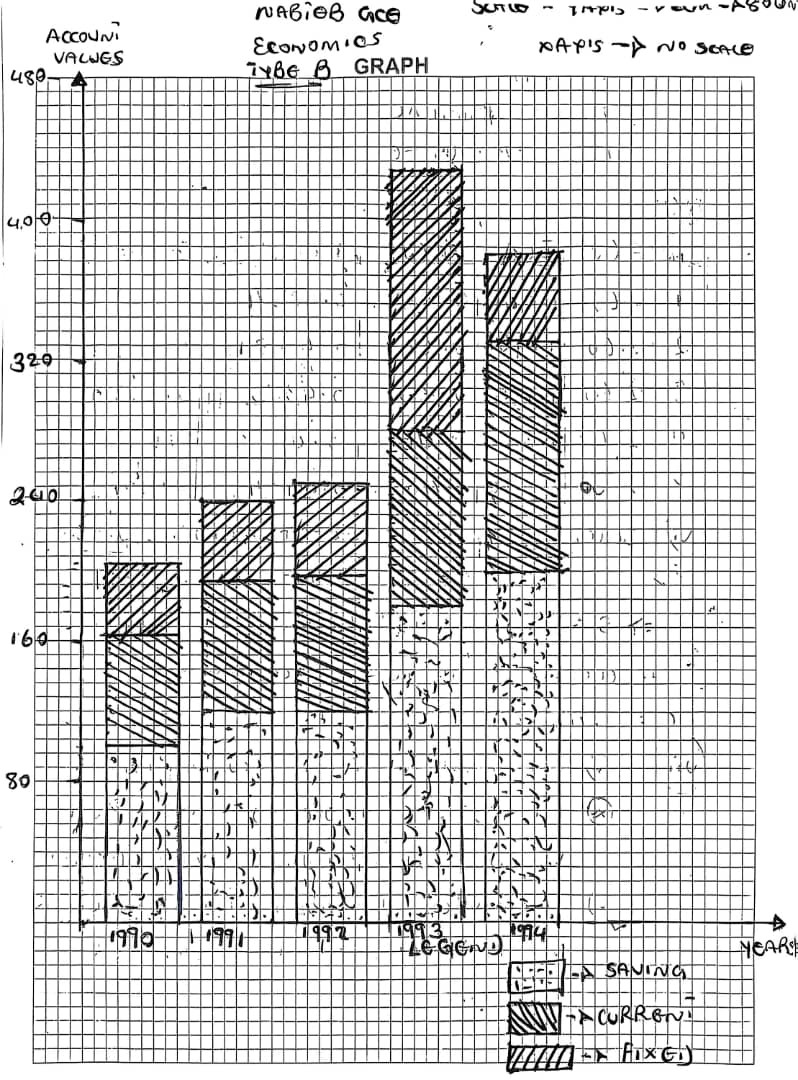
===================================
SECTION A: ANSWER FOUR(4) QUESTIONS ONLY
(3a)
A one-man business, also called a sole proprietorship, is a type of business enterprise owned, financed, and controlled by one individual who bears all the risks and receives all the profits. The owner makes all decisions alone and is personally responsible for the debts of the business, meaning there is unlimited liability. It is the simplest form of business organization, commonly found in petty trading, small retail shops, artisanship, and small-scale services.
(3b)
(i) Ability to Raise Large Capital: A joint-stock company can raise large amounts of capital by selling shares to many investors. This makes it easier to finance large-scale projects, expansions, and new technologies. In contrast, a one-man business depends solely on the savings and borrowing capacity of one person, which limits its financial strength.
(ii) Limited Liability for Members: In a joint-stock company, shareholders enjoy limited liability, meaning they can only lose the amount they invested. Their personal property cannot be taken to settle company debts. A one-man business, however, has unlimited liability, exposing the owner’s personal assets to business risks, making the joint-stock structure safer for investors.
(iii) Continuity of Existence: A joint-stock company has perpetual succession. The death, withdrawal, or insolvency of any shareholder does not affect its existence. It continues to operate as a separate legal entity. In contrast, a one-man business often ends or becomes unstable when the owner dies or becomes incapacitated.
(iv) Better Management and Specialization: Joint-stock companies employ skilled managers, accountants, engineers, and other professionals. This leads to specialization, division of labour, and efficient management. A one-man business relies mainly on the owner’s personal skills, which may be limited, reducing efficiency and growth potential.
===================================
(4a)
Abnormal demand refers to a situation where the demand for a good or service does not follow the usual law of demand. In normal circumstances, as price increases, demand decreases. In abnormal demand, however, demand may increase with a rise in price or decrease with a fall in price, contrary to the typical downward-sloping demand curve. This behavior is often due to factors such as consumer perception, speculation, or the status associated with the product.
(4b)
(i) Giffen Goods: For Giffen goods, an increase in price may lead to an increase in quantity demanded because the good is an inferior staple. When the price rises, consumers cannot afford better alternatives and end up buying more of the Giffen good. This makes the demand curve slope upwards instead of downwards.
(ii) Veblen or Prestige Goods: Certain goods, like luxury cars, designer clothes, or expensive watches, are considered status symbols. Higher prices make these goods more desirable as they signal wealth and prestige. Therefore, as price rises, demand rises, causing an upward-sloping demand curve.
(iii) Speculative Demand: When buyers expect that the price of a good will rise in the future, they may buy more now even if the current price is high. This speculative behavior can make the demand curve slope upwards temporarily.
(iv) Necessities with No Substitutes: For goods that are essential for survival or daily life, consumers may continue buying almost the same quantity regardless of price changes. In extreme cases, demand may not decrease with higher prices, making the demand curve vertical or nearly perfectly inelastic.
===================================
(5a)
A population census is the official count and collection of information about all the people living in a country at a particular time. It gathers data on the size, distribution, composition, and characteristics of the population, such as age, sex, occupation, and education. The purpose is to provide an accurate demographic picture to aid in planning and policy formulation.
(5b)
(i) Planning of Public Services: Census data helps governments plan for schools, hospitals, roads, and housing by knowing where people live and their needs.
(ii) Economic Planning: It provides information for budgeting, taxation, and development policies to allocate resources efficiently.
(iii) Population Policy Formulation: It helps in designing policies on health, family planning, and social welfare based on population growth trends.
(iv) Political Representation: Census figures are used to determine constituencies, allocate seats in parliament, and ensure fair representation.
===================================
(6a)
The capital market is the financial market where long-term funds and securities such as shares, debentures and government bonds are bought and sold. It provides a platform through which businesses and governments can raise funds for long-term development projects, usually for periods of more than one year. The market is made up of institutions such as the stock exchange, issuing houses, investment banks and stockbrokers.
(6b)
(i) It provides long-term financing for investment.
(ii) It promotes capital formation and economic growth.
(iii) It offers higher returns to investors.
(iv) It provides opportunities for ownership and control of companies through share acquisition.
(6c)
(i) Provision of long-term financing: The capital market makes long-term loans and funds available to industries and governments. Unlike the money market, which deals with short-term borrowing, the capital market supports projects that require funding over many years such as expansion of factories, construction, or acquisition of heavy machinery.
(ii) Promotion of capital formation and economic growth: By mobilizing savings from individuals and institutions, the capital market channels these funds into productive investments. This leads to increased production, job creation and overall economic development.
(iii) Higher returns to investors: Investors in the capital market often earn higher returns through dividends, interest on long-term bonds, and capital gains when share prices appreciate. These returns are generally higher than those earned in the money market, which deals mainly with low-risk, low-yield securities.
(iv) Opportunity for ownership and control: Through the purchase of shares, individuals can become part-owners of companies. This gives them rights such as voting in company meetings and participating in major decisions. The money market does not provide such opportunities since it deals with lending and borrowing rather than ownership.
===================================
(7a)
(i) Promote Economic Integration: ECOWAS aims to create a single regional market by removing trade barriers such as tariffs and quotas among member states. This facilitates free trade of goods and services, encourages investment, and strengthens the economic position of West Africa in the global market. For example, the ECOWAS Trade Liberalization Scheme (ETLS) allows member countries to trade certain products without customs duties.
(ii) Enhance Peace and Security: A key objective is to maintain peace, security, and political stability in the region. ECOWAS intervenes diplomatically and militarily in conflicts to prevent wars, protect civilians, and ensure smooth functioning of member states. For instance, ECOWAS has played a role in peacekeeping missions in Liberia and Sierra Leone.
(iii) Encourage Socio-Economic Development: ECOWAS seeks to promote coordinated development in infrastructure, agriculture, industry, and energy. This includes planning regional projects such as cross-border highways, electricity interconnections, and agricultural development programs to raise living standards and reduce poverty.
(iv) Foster Social, Cultural, and Political Cooperation: ECOWAS promotes cooperation in social, cultural, and political matters to strengthen regional unity. Initiatives include education exchange programs, health campaigns, youth development, and collaboration on scientific and technological projects. Such efforts build solidarity and enhance shared identity among West Africans.
(7b)
(i) Political Instability in Member States: Frequent civil unrest, coups, and governance challenges make it difficult for ECOWAS to enforce regional policies effectively.
(ii) Limited Financial Resources: Dependence on member contributions and external funding restricts ECOWAS’s ability to implement projects, maintain peacekeeping missions, and support development initiatives.
===================================
(8a)
(i) To determine the level of economic development.
(ii) To facilitate economic planning and policy formulation.
(iii) To compare standard of living over time.
(iv) To analyze economic performance and growth.
(v) To guide resource allocation and investment decisions.
(8b)
(i) To determine the level of economic development: Measuring national income helps a country assess its wealth and production capacity. It shows how much the economy produces and earns in a given period, indicating whether the country is developing, underdeveloped, or advanced.
(ii) To facilitate economic planning and policy formulation: National income statistics provide accurate data that government planners use to design fiscal, monetary, and development policies. This ensures policies are based on actual economic conditions rather than guesswork.
(iii) To compare standard of living over time: By tracking changes in per capita income and total national income, a country can evaluate whether citizens’ living standards are improving or declining, helping policymakers address poverty and inequality.
(iv) To analyze economic performance and growth: National income measurement enables the government to monitor economic growth rates, identify sectors performing well, and detect sectors that need support. This helps in formulating strategies for sustainable growth.
(v) To guide resource allocation and investment decisions: Knowing the national income helps in deciding where to invest public and private resources, ensuring that scarce resources are used efficiently for maximum economic benefit, such as in infrastructure, education, and healthcare.
===================================
COMPLETED….We Remain Your Favourite Site.
Ensure You Subscribe For Your Next Paper
===================================
Leave a Reply