
 HOME
 WAEC
 NECO
 07048281409
BEST EXPO RUNZ ASSISTANCE WEBSITE. NO.1 BEST DELIVERY OF EXAM RUNZ
100% GUARANTEE OF GETTING ANSWERS MIDNIGHT..IT’S OUR CULTURE, NO DOUBT
═══════════════════════════
SECTION A: ANSWER ALL QUESTIONS
(1)
(i) Ensure adequate ventilation to remove harmful welding fumes and gases from the confined space.
(ii) Wear appropriate personal protective equipment (PPE), and ensure that a fire extinguisher is readily available.
═══════════════════════════
(2)
(i) Type of metal being welded: The shielding gas must be suitable for the base metal, such as steel, aluminium or stainless steel.
(ii) Welding conditions and requirements: Consider the required penetration, arc stability, weld quality and welding position.
═══════════════════════════
(3a)
A contactor is an electrically operated switching device used to connect and disconnect the welding power supply to the TIG welding circuit.
(3b)
(i) Ceramic.
(ii) Glass.
═══════════════════════════
(4)
(i) Method of welding: Spot welding joins metal sheets at separate points, while seam welding joins them continuously along a line.
(ii) Electrodes used: Spot welding uses two electrode tips, while seam welding uses rotating wheel-shaped electrodes.
═══════════════════════════
(5)
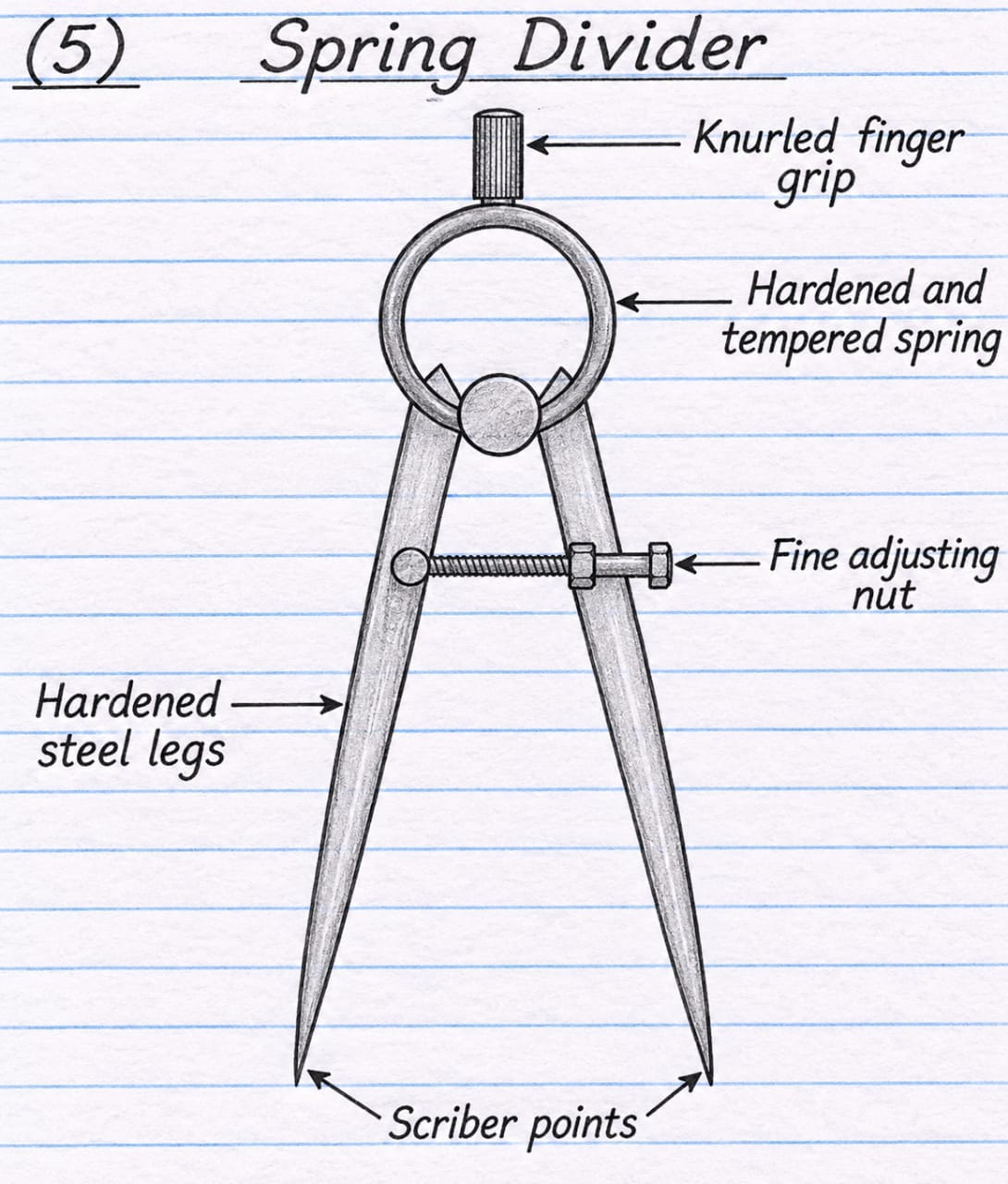
═══════════════════════════
(6a)
Overhead welding is a welding position in which the welder joins metal from underneath the workpiece, with the weld made above the welder’s head.
(6b)
(i) Molten metal and hot slag tend to fall downwards due to gravity, making it difficult to control the weld pool.
(ii) The welder must work in an uncomfortable position while maintaining proper control of the electrode and welding arc.
═══════════════════════════
(7)
(i) It produces more accurate and uniform cuts because the cutting torch follows a predetermined profile.
(ii) It increases cutting speed and productivity while reducing operator fatigue and manual effort.
═══════════════════════════
(8)
Stress is the internal resisting force per unit area developed in a material when an external force is applied, while strain is the ratio of the change in dimension of a material to its original dimension.
═══════════════════════════
(9a)
Boring tools:
(i) Twist drill.
(ii) Boring bar.
(9b)
Power hand tools:
(i) Electric hand drill.
(ii) Portable angle grinder.
═══════════════════════════
(10a)
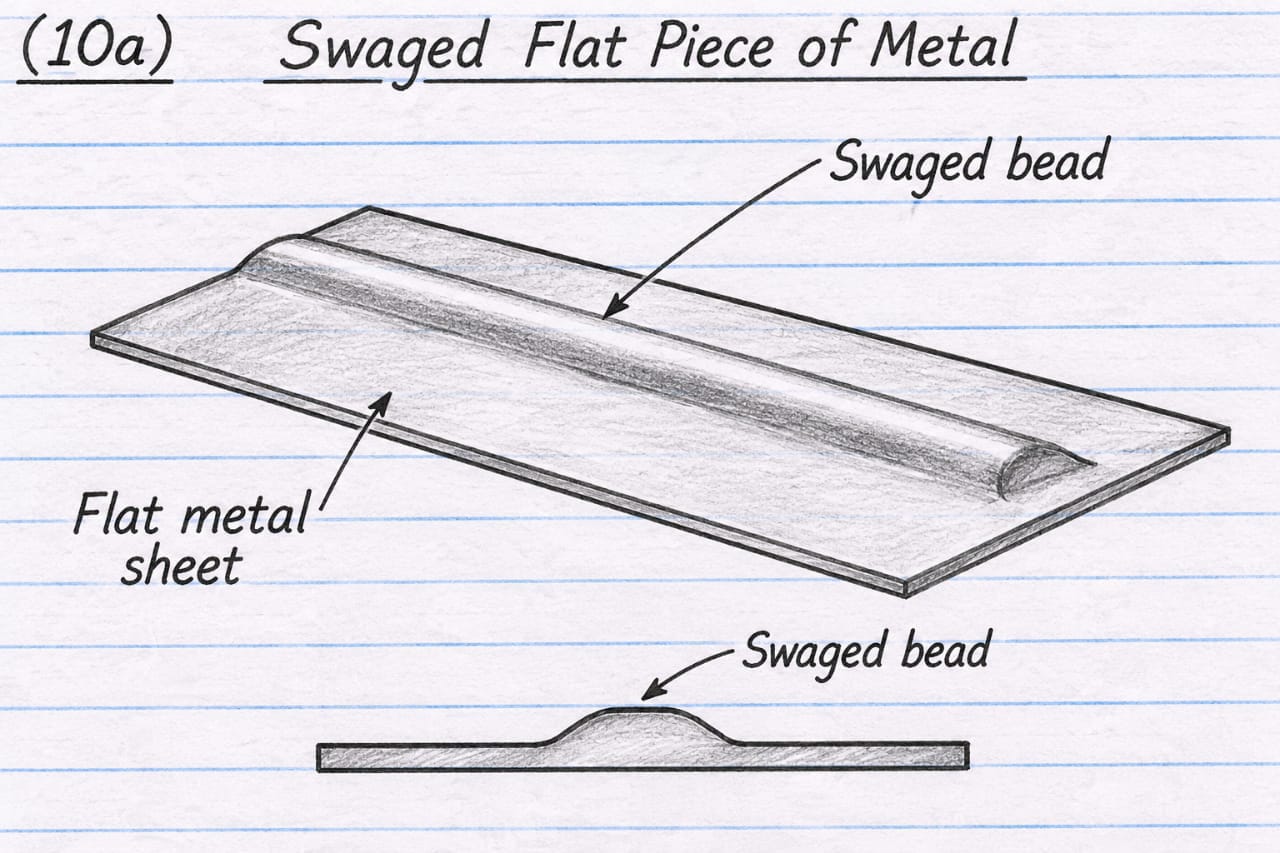
(10b)
A safe edge is a folded or turned edge of sheet metal that removes the sharp exposed edge, making the metal safer to handle and improving the strength and finish of the work.
═══════════════════════════
SECTION B: ANSWER FIVE(5) QUESTIONS ONLY
(11a)
(i) Arc eye (welder’s flash).
(ii) Cataracts.
(iii) Retinal damage.
(11b)
(i) During arc welding to protect the face and eyes from intense light and harmful radiation.
(ii) During overhead welding to protect the head and face from falling sparks, molten metal and hot slag.
(iii) During welding operations that produce heavy sparks, spatter and flying particles.
(11ci)
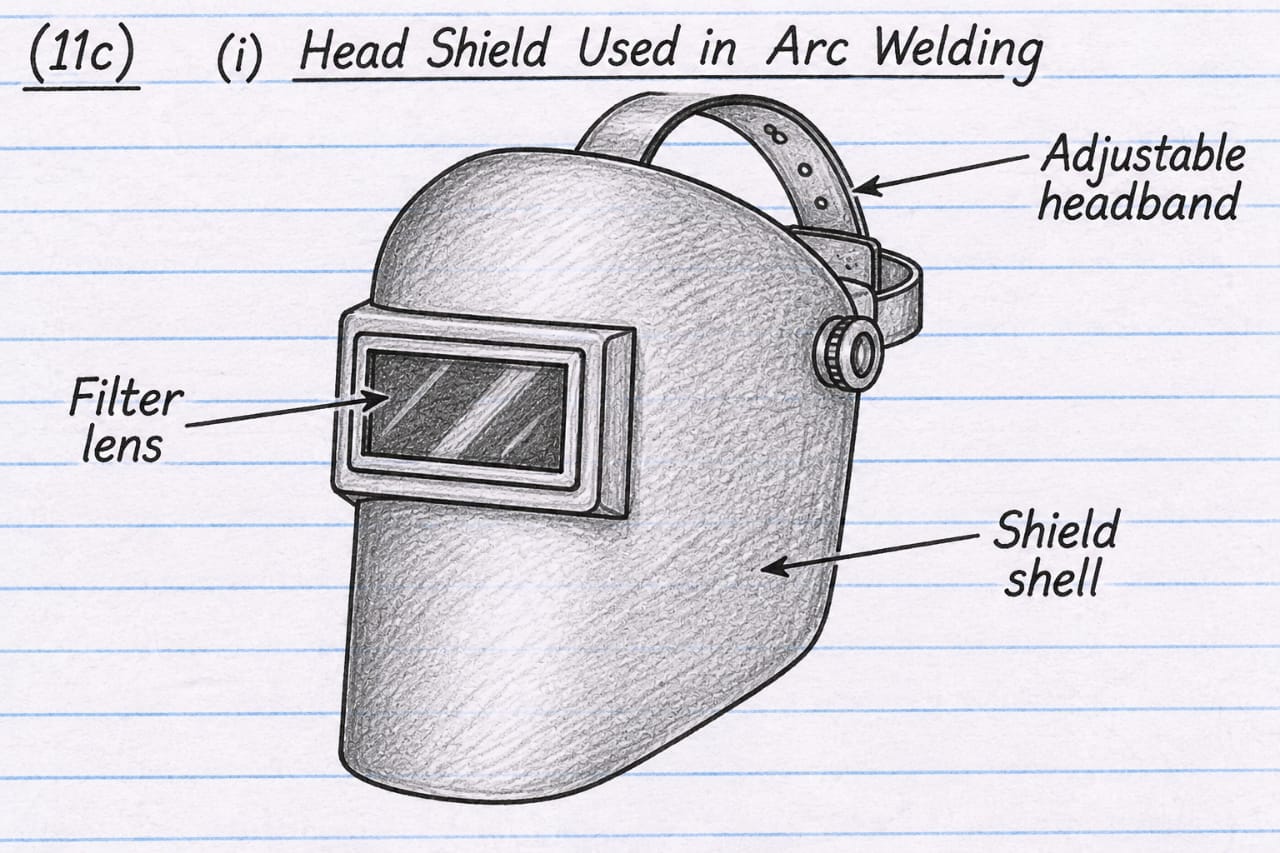
(11cii)
(Pick any two)
(i) Filter lens.
(ii) Shield shell.
(iii) Adjustable headband.
═══════════════════════════
(12a)
(i) TIG welding is an arc welding process in which heat is produced by an electric arc between a non-consumable tungsten electrode and the workpiece. An inert shielding gas, usually argon or helium, protects the weld pool from atmospheric contamination. Filler metal may be added separately when required.
(ii) MIG welding is an arc welding process in which an electric arc is formed between a continuously fed consumable wire electrode and the workpiece. An inert shielding gas protects the molten weld metal from atmospheric contamination.
(12bi)
(i) TIG welding produces cleaner and more precise welds with little or no spatter.
(ii) TIG welding provides better control of heat and filler metal, making it suitable for welding thin materials.
(12bii)
Increasing the wire feed speed generally increases the welding current and the rate at which filler metal is deposited. This can increase weld penetration and welding productivity. However, excessive wire speed may cause spatter and poor weld formation.
═══════════════════════════
(13ai) & (13aii)
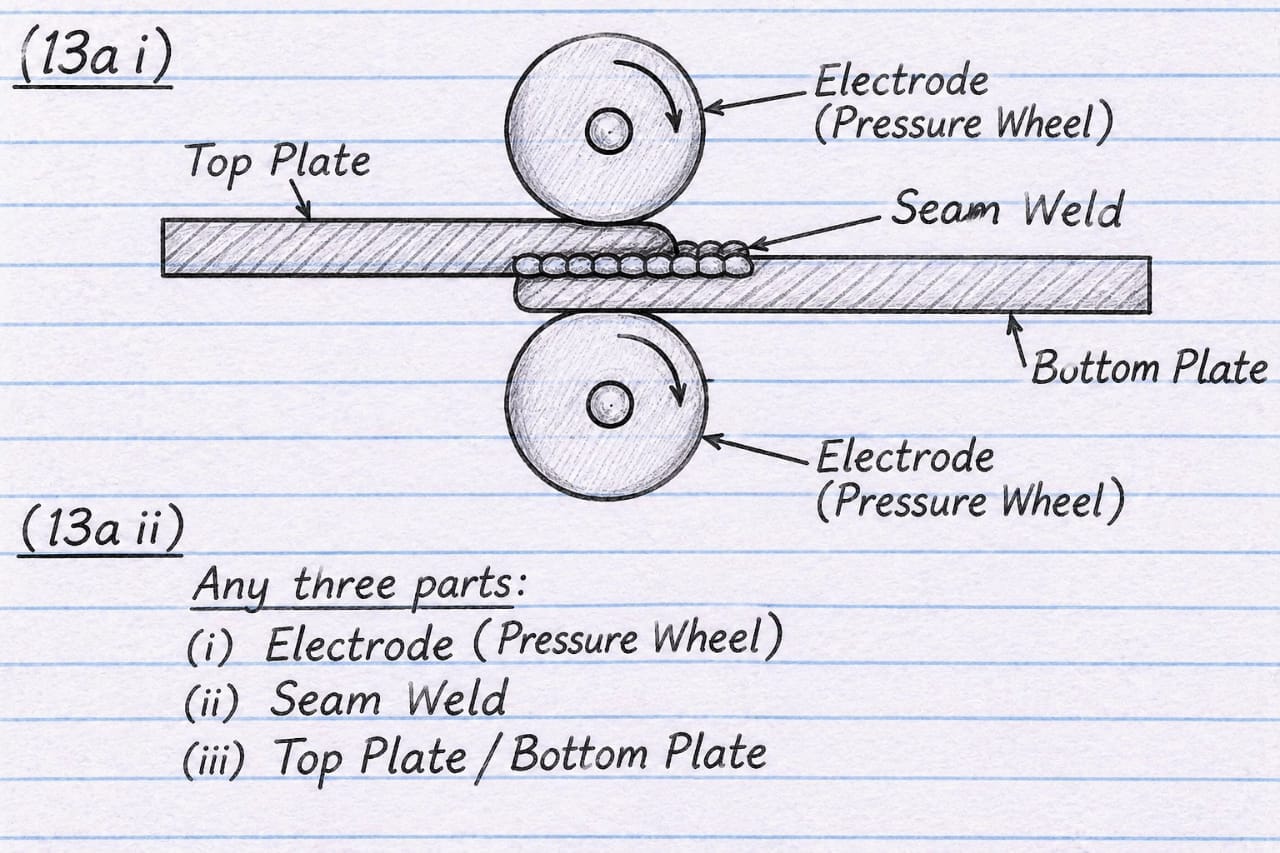
(13b)
(i) W: Workpiece (base metal).
(ii) X: Contact tip.
(iii) Y: Insulated guide (nozzle).
(iv) Z: Welding arc.
═══════════════════════════
(14a)
Submerged arc welding (SAW) is an arc welding process in which an electric arc is formed between a continuously fed consumable electrode and the workpiece beneath a layer of granular flux. The flux covers the arc and molten weld pool, protecting them from atmospheric contamination. It is commonly used for welding thick metal plates.
(14b)
(i) Welding is used to join two or more metal components permanently to produce strong and durable structures.
(ii) It reduces the need for bolts, nuts and other mechanical fasteners, thereby saving materials, weight and production costs.
(14c)
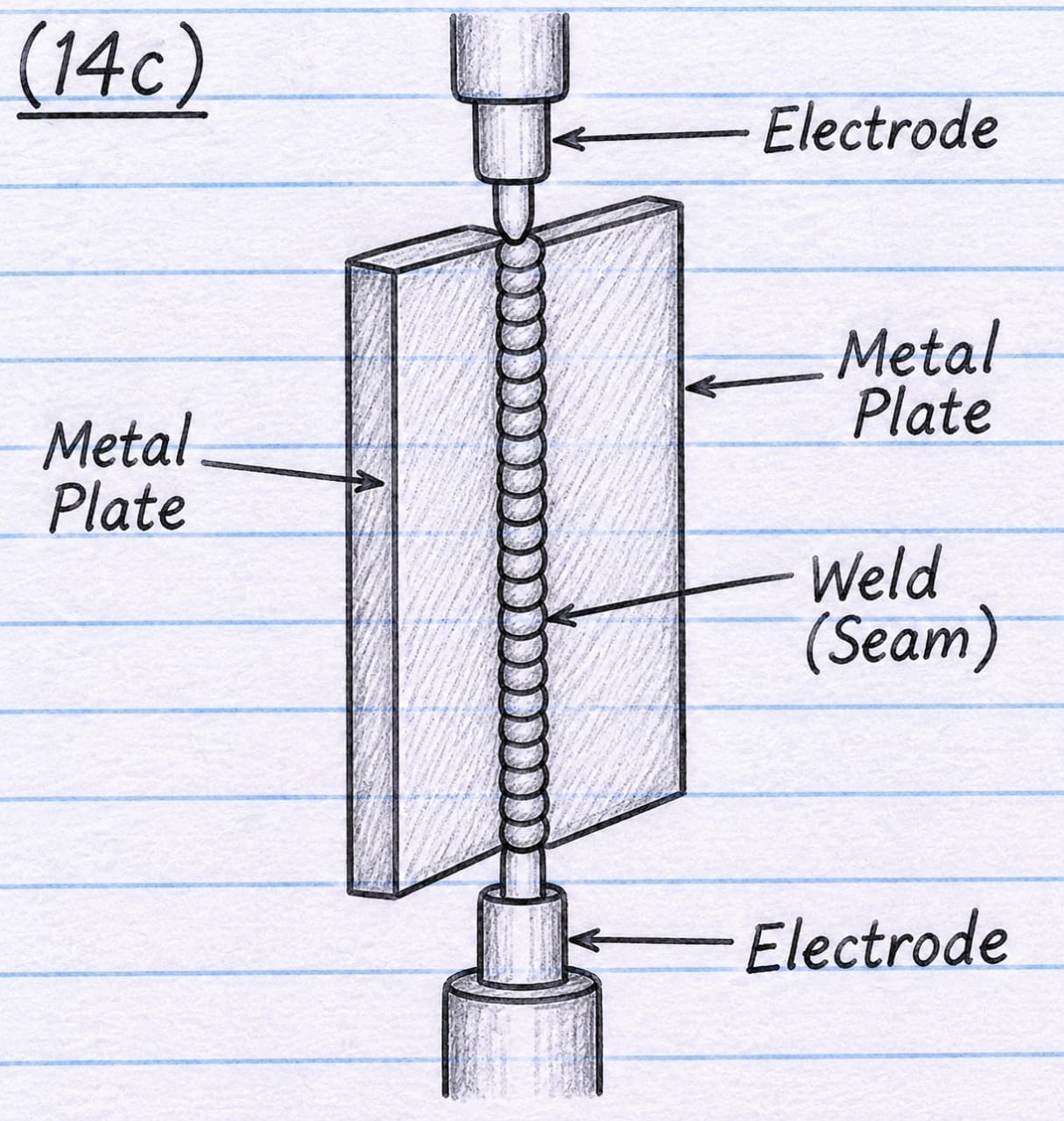
(14d)
(i) Butt welding.
(ii) Socket welding.
═══════════════════════════
(15a)
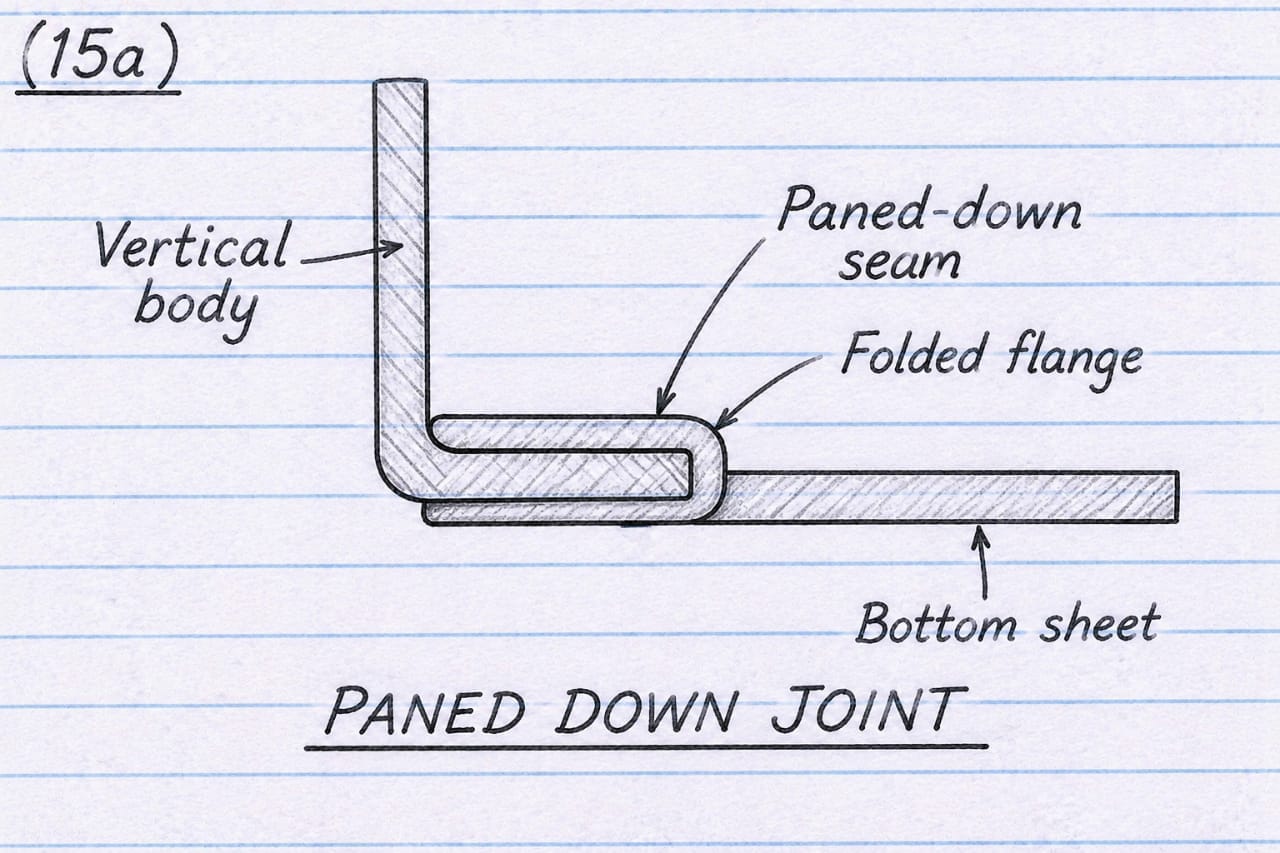
(15b)
(i) Twisting is a form of distortion in which a welded component becomes turned or rotated out of its original position due to uneven heating and cooling during welding.
(ii) Buckling is the bending or deformation of a welded plate or component caused by compressive stresses and uneven expansion and contraction during welding.
(iii) Cracking is the formation of a fracture or split in the weld metal or heat-affected zone due to excessive stress, rapid cooling, hydrogen contamination or improper welding procedures.
(15c)
(i) Oxygen.
(ii) Nitrogen.
═══════════════════════════
(16a)
Given:
(i) Height, h = 130 mm
(ii) Major diameter = 180 mm, so R = 90 mm
(iii) Minor diameter = 120 mm, so r = 60 mm
Slant height:
l = √(h² + (R − r)²)
l = √(130² + 30²)
l = √(16900 + 900)
l = √17800
l = 133.42mm
Curved surface area:
A = π(R + r)l
A = π × 150 × 133.42
A = (22/7) × 20013
A = 62,898mm²
Area of the two circular ends:
πR² + πr² = (22/7) × (8100 + 3600)
= (22/7) × 11700
= 257400/7
= 36,771mm²
Total surface area:
= 62,898 + 36,771
= 99,669mm²
(16b)
(i) To reduce the thickness of metal sheets or plates by passing them between rotating rollers.
(ii) To bend or curve metal sheets and plates into cylindrical, circular or other required shapes.
═══════════════════════════
(17a)
Galvanising is the process of coating iron or steel with a protective layer of zinc to prevent rusting and corrosion. It is commonly carried out by dipping the metal into molten zinc.
(17bi)
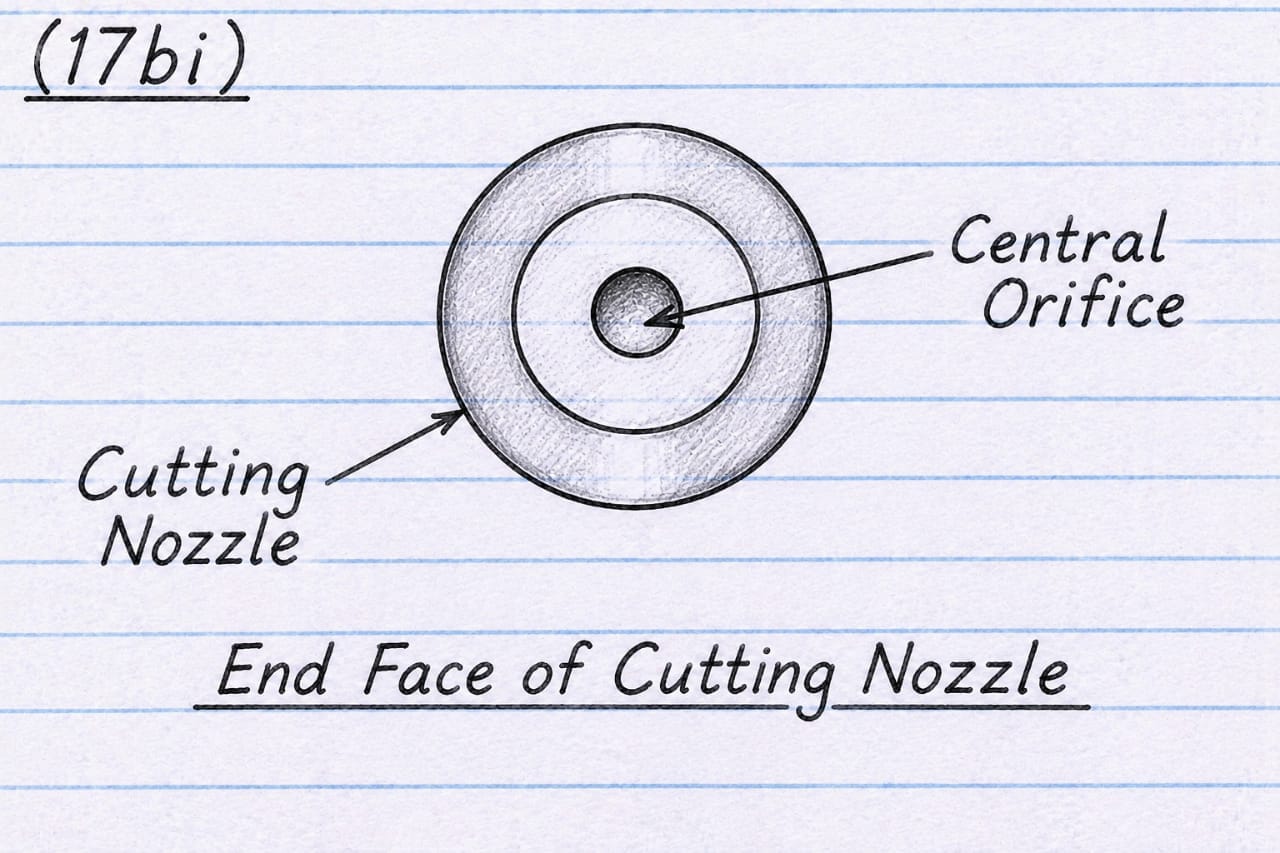
(17bii)
(i) Correct gas pressure.
(ii) Proper cutting speed.
(iii) Correct nozzle size and condition.
═══════════════════════════
COMPLETED….We Remain Your Favourite Site.
Ensure You Subscribe For Your Next Paper
═══════════════════════════
Leave a Reply