
 HOME
 WAEC
 NECO
 07048281409

BEST EXPO RUNZ ASSISTANCE WEBSITE. NO.1 BEST DELIVERY OF EXAM RUNZ
100% GUARANTEE OF GETTING ANSWERS MIDNIGHT..IT’S OUR CULTURE, NO DOUBT
═══════════════════════════
SECTION A: ANSWER ALL QUESTIONS
(1a)
A Database Management System (DBMS) is a software system used to create, store, organise, retrieve, update and manage data in a database.
(1b)
(i) Microsoft Access.
(ii) Oracle Database.
═══════════════════════════
(2)
(i) Computers.
(ii) Printers.
(iii) Scanners.
(iv) Uninterruptible Power Supply (UPS).
═══════════════════════════
(3)
(i) It supports decision-making, especially in solving semi-structured and unstructured problems.
(ii) It uses data and analytical models to evaluate different alternatives.
(iii) It is interactive and allows users to participate in the decision-making process.
(iv) It provides flexible reports and information for effective decision-making.
═══════════════════════════
(4a)
Data redundancy is the unnecessary duplication or repetition of the same data in different locations within a database or information system.
(4b)
(i) It allows a record to have multiple parent records, making it easier to represent complex relationships.
(ii) It provides more flexible data access because records can be linked through multiple paths.
═══════════════════════════
(5)
(i) Obtain the encrypted data (ciphertext).
(ii) Obtain the correct decryption key.
(iii) Select the appropriate decryption algorithm.
(iv) Apply the decryption key and algorithm to the encrypted data.
(v) Convert the resulting data into its original readable form (plaintext).
═══════════════════════════
(6)
(i) It helps to organise data and show the relationships between different data entities.
(ii) It provides a clear structure for database design and reduces data duplication and inconsistency.
═══════════════════════════
(7a)
(i) Absolute coordinate method.
(ii) Relative coordinate method.
(iii) Polar coordinate method.
(7b)
(i) Absolute coordinate method: This method involves specifying the exact position of a point using coordinates measured from the fixed origin (0,0) of the drawing area.
(ii) Relative coordinate method: This method involves specifying a point’s position using distances measured from the previously entered point.
(iii) Polar coordinate method: This method involves specifying a point by giving its distance and angle from the previous point.
═══════════════════════════
(8)
(a) False flooring: False flooring is a raised floor installed above the original floor to create space for electrical cables, data cables and other service installations.
(b) False roofing: False roofing is a secondary ceiling or roof structure installed below the main roof to conceal installations, improve appearance and provide insulation.
═══════════════════════════
(9)
(i) Parallel run: Parallel run is a system conversion method in which the old and new systems operate simultaneously for a period until the new system is confirmed to be working correctly.
(ii) Direct changeover: Direct changeover is a system conversion method in which the old system is stopped and the new system is introduced immediately without running both systems together.
═══════════════════════════
(10a)
(i) Honesty and integrity.
(ii) Technical competence and problem-solving ability.
(10b)
(i) Computer Professionals (Registration Council of Nigeria) (CPN).
(ii) Nigeria Computer Society (NCS).
═══════════════════════════
SECTION B: ANSWER FIVE(5) QUESTIONS ONLY
(11a)
An open-loop system is a system in which the output does not influence or control the input. It operates without feedback, meaning that the system performs its function without checking whether the desired result has been achieved.
(11b)
(i) It is simple to design and easy to operate.
(ii) It is relatively cheap to construct and maintain because it does not require feedback devices.
(iii) It operates quickly because there is no need to measure and compare the output with the desired result.
(iv) It is generally stable because its operation does not depend on feedback.
═══════════════════════════
(12)
(i) Naming of data elements:
Naming of data elements is the process of assigning unique, meaningful and consistent names to individual data items in a database. It helps users and database administrators to identify, understand and retrieve data easily. Good naming conventions reduce confusion and improve database organisation.
(ii) Single and multiple applications of database system:
A single application of a database system refers to the use of a database to support one particular application or function, such as a payroll system used to calculate employees’ salaries.
Multiple applications of a database system refer to the use of one common database by several applications or departments. For example, a university database may be used by the admission, examination, finance and library departments. This encourages data sharing and reduces unnecessary duplication.
(iii) Host language service:
Host language service refers to the facility that allows database operations to be incorporated into a general-purpose programming language, such as COBOL, C or Java. It enables application programmes to communicate with the database, retrieve and update records, and process the information obtained.
═══════════════════════════
(13a)
Deterministic system:
A deterministic system is a system whose behaviour and output can be predicted with certainty when the input and operating conditions are known. The same input under the same conditions always produces the same output. An example is a simple mathematical calculator.
(13b)
Probabilistic system:
A probabilistic system is a system whose behaviour or output cannot be predicted with complete certainty because it involves chance or uncertainty. Its results are usually estimated using probability. An example is a weather forecasting system.
(13c)
Static system:
A static system is a system whose condition or structure does not change with time. It represents a situation at a particular point in time. An example is an organisation’s fixed organisational chart.
(13d)
Dynamic system:
A dynamic system is a system whose condition or behaviour changes with time due to changes in its inputs or operating environment. An example is a traffic control system in which traffic conditions change continuously.
═══════════════════════════
(14a)
The Cartesian coordinate system locates a point by specifying its horizontal (X) and vertical (Y) distances from a fixed origin, while the Polar coordinate system locates a point by specifying its distance and angle from a reference point.
In the Cartesian system, coordinates are expressed as (X, Y), while in the Polar system, they are expressed as (distance, angle).
For example, a point at (4, 3) in Cartesian coordinates is located 4 units along the X-axis and 3 units along the Y-axis, while a point at (5, 36.87°) in Polar coordinates is located 5 units from the origin at an angle of 36.87° to the positive X-axis.
(14b)
(i) Array: The Array command is used to create multiple copies of selected objects arranged in a rectangular, polar or path pattern.
(ii) Fillet: The Fillet command is used to join two lines or objects with a rounded corner of a specified radius.
(iii) Offset: The Offset command is used to create parallel copies of lines, curves or other objects at a specified distance from the original object.
(iv) Chamfer: The Chamfer command is used to create a sloping or bevelled edge between two lines or objects by cutting off their sharp corner.
═══════════════════════════
(15a)
A declarative programming language specifies what result is required without describing the exact steps to achieve it, while a procedural programming language specifies the step-by-step instructions needed to perform a task.
Declarative languages focus on the desired outcome, while procedural languages focus on the procedure or method used to obtain the outcome.
Declarative languages generally allow the programmer to express instructions using rules or logical statements, while procedural languages use commands, variables, loops and procedures to control program execution.
(15b)
(i) COBOL.
(ii) FORTRAN.
═══════════════════════════
(16a)
AutoCAD is a computer-aided design (CAD) software developed by Autodesk and used for creating, editing and modifying accurate two-dimensional (2D) drawings and three-dimensional (3D) models.
(16b)
ADVANTAGES:
(i) It improves drawing accuracy and precision, making it easier to produce detailed architectural plans.
(ii) It saves time because drawings can be edited, copied and modified easily without redrawing everything.
(iii) It allows easy storage, retrieval and sharing of architectural drawings in digital formats.
DISADVANTAGES:
(i) It requires expensive computers, software licences and regular maintenance.
(ii) It requires specialised training and technical skills to operate effectively.
(iii) Power failure or computer system breakdown can interrupt work and lead to loss of unsaved drawings.
═══════════════════════════
(17a)
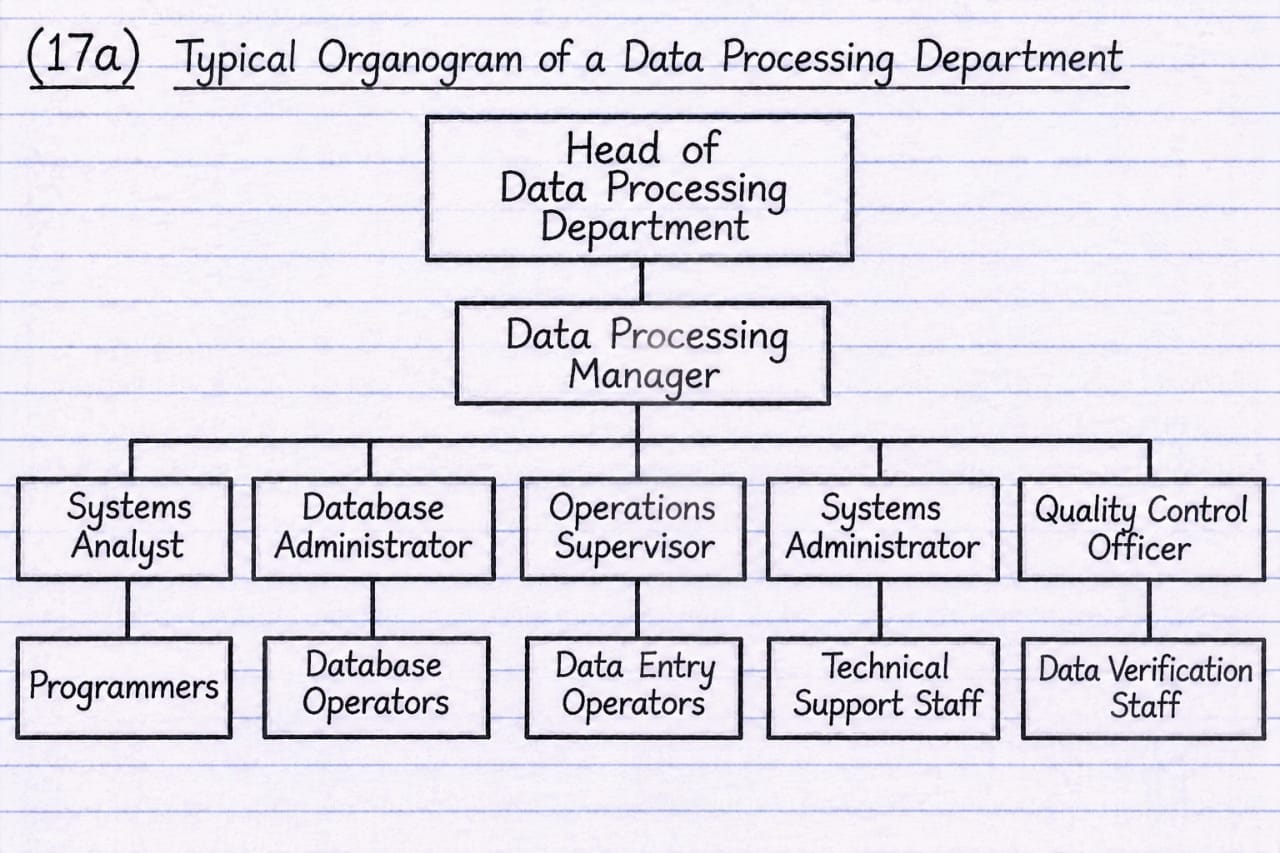
(17b)
(i) Head of Data Processing Department:
The head is responsible for the overall administration and control of the data processing department. He makes major decisions, sets departmental policies, allocates resources and ensures that the department achieves its objectives.
(ii) Data Processing Manager:
The manager supervises the daily activities of the department. He coordinates the different sections, assigns duties to staff, monitors their performance and ensures that data processing operations are carried out efficiently.
(iii) Section Heads / Supervisors:
They are responsible for supervising specific units within the department, such as systems analysis, database administration, computer operations, systems administration and quality control. They assign tasks to their subordinates, ensure that work is properly carried out and report progress to the Data Processing Manager.
═══════════════════════════
COMPLETED….We Remain Your Favourite Site.
Ensure You Subscribe For Your Next Paper
═══════════════════════════
Leave a Reply