
 HOME
 WAEC
 NECO
 07048281409

BEST EXPO RUNZ ASSISTANCE WEBSITE. NO.1 BEST DELIVERY OF EXAM RUNZ
100% GUARANTEE OF GETTING ANSWERS MIDNIGHT..IT’S OUR CULTURE, NO DOUBT
===================================
BIOLOGY OBJECTIVE
Use these answers to trace on your booklet .
1. D – blood group
2. C – discontinuous
3. B – formed in anaphase II
4. C – 75%
5. C – anaphase of mitosis
6. A – 8
7. A – haemophilia
8. B – a stable environment
9. C – variation
10. B – sedimentary rocks
11. B – numbers
12. A – grasses
13. D – faeces
14. C – one partner benefits and the other neither loses nor benefits
15. D – periodic shedding of exoskeleton for growth
16. D – possesses haustoria
17. B – using old newspapers to make tissue papers
18. B – Increase in number of antelopes
19. D – petroleum, coal, tin and copper
20. D – exploiting new crude oil reserves
21. C – I and II only
22. B – fertilization
23. A – undergo mitotic division
24. B – earthworm and hydrostatic skeleton
25. C – parenchyma
26. A – erythrocyte
27. C – is excreted with minimal water loss
28. C – maintenance of a steady internal environment of the body
29. C – imbibition
30. D – medulla oblongata
31. A – oestrogen
32. A – a virus
33. B – Spirogyra → fern → cycad → Tridax
34. C – possess chlorophyll
35. B – mitochondrion
36. B – II, IV and V
37. D – photosynthesis
38. B – Contractile vacuole and kidney
39. B – movement and nutrition
40. B – chloroplast
41. A – carbon (IV) oxide
42. A – potometer
43. C – stomata
44. D – NADP
45. C – hydra
46. B – saprophytic
47. B – diabetes
48. C – increased competition and food shortage
49. A – encourage birth control measures
50. A – light, rainfall and temperature
===================================
SECTION A: ANSWER TWO(2) QUESTIONS ONLY
(1ai)
Pollination (cross-pollination)
(1aii)
Pollen grains are transferred from the anther of one flower to the stigma of another flower of the same species by bees. This stimulates fertilization and triggers flowering
(1bi)
(i) Hairy body that traps and carries pollen grains.
(ii) Ability to detect bright colours and scent, attracting them to flowers.
(1bii)
(i) Brightly coloured petals that attract bees.
(ii) Production of nectar and scent to lure bees.
(1c)
Flowers provide nectar which bees use as food and to produce honey.
(1di)
(i) Stamen (anther + filament)
(ii) Pistil/Carpel (stigma, style, ovary)
(1dii)
(i) Petals (corolla)
(ii) Sepals (calyx)
(1e)
One male nucleus fuses with the egg cell to form a diploid zygote (embryo), while the second fuses with the two polar nuclei to form a triploid endosperm nucleus. Since two fusions occur, it is called double fertilization.
(1f)
(i) Dry dehiscent pod that splits explosively, scattering seeds.
(ii) Light pod structure that can be carried by wind or water.
(1g)
[COMPLETE THE TABLE]
(i) Cowpea – Marginal placentation
(ii) Okra – Axile placentation
(iii) Pawpaw – Parietal placentation
===================================
(2a)
Translocation is the process by which manufactured food substances are transported from the leaves to other parts of the plant through the phloem tissue.
(2b)

(2c)

===================================
(4a)
The behaviour is called Social behaviour and the group is called a Colony
(4b)
Complete the table;
Under; Four likely members of the insect community;
(i)Queen
(ii)Worker
(iii)Soldier
(iv)Drone (male)
Under; One role of the member;
(i)Lays eggs / reproduction
(ii)Forages for food and feeds the colony / builds nest
Mandibles / forelegs / honey stomach
(iii)Defends the colony against enemies
Large powerful mandibles / strong jaws
(iv)Mates with the queen for reproduction
Under: One structure for performing the role
(i)Enlarged ovaries / large abdomen
(ii)Mandibles / forelegs / honey stomach
(iii)Large powerful mandibles / strong jaws
(iv)Testes / wings
(4c)
(i) Bees
(ii) Ants
(4di)
(i) Division of labour
Protection against predators and enemies
(ii) Care of young ones (brood care)
(4dii)
(i) Chemical communication (pheromones)
(ii) Dance communication
===================================
SECTION B: ANSWER ALL QUESTIONS
(5a)
Energy flow in an ecosystem is non-cyclic because energy enters the ecosystem from the sun and passes through producers and consumers. At each trophic level, some energy is lost as heat during respiration and cannot be recycled. Therefore, energy must be continuously supplied from the sun.
(5b)
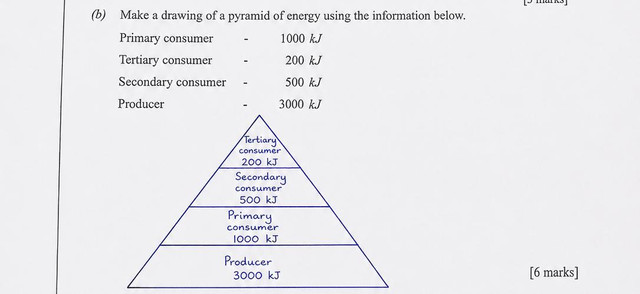
(5c)
[TABULATE]
=Pyramid of Energy=
(i) Shows energy at each trophic level
(ii) Always upright in shape
(iii) Measured in kilojoules (kJ)
=Pyramid of Numbers=
(i) Shows the number of organisms at each trophic level
(ii) May be upright or inverted
(iii) Measured in numbers of organisms
(5di)
Energy can neither be created nor destroyed, but can only be transformed from one form to another. The total energy in a closed system remains constant.
(5dii)
In every energy transformation, some energy is lost as heat to the surroundings. This makes energy conversions inefficient and increases the disorder (entropy) of the system.
(5e)
(i) It has no digestive system and absorbs already-digested food directly through its body surface (tegument).
(ii) It has a long, flat body which provides a large surface area for absorption of nutrients.
(iii) Its body surface has microvilli which increase surface area for efficient absorption.
(5fi)
-A: Aquatic habitat (water) because it has gills.
-B: Terrestrial habitat (land) because it has lungs.
(5fii)
A (Aquatic habitat):
(i) Dissolved oxygen
(ii) Water current
B (Terrestrial habitat):
(i) Humidity
(ii) Wind speed
===================================
COMPLETED….We Remain Your Favourite Site.
Ensure You Subscribe For Your Next Paper
===================================
Leave a Reply